
SAMAJ WEEKLY UK

Bal Ram Sampla
Geopolitics
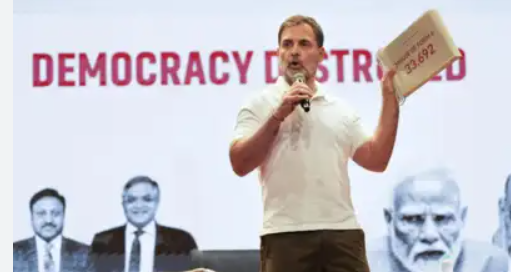
For months now, Rahul Gandhi has been loudly accusing the Election Commission of India (EC) of failing to protect democracy. He claims there was “vote theft” in recent elections — that voter lists were manipulated, fake names added, and genuine voters removed to help the ruling party. Such claims, if true, would be serious attacks on India’s democratic process.
The EC’s Demand for Proof
The Election Commission responded by inviting Gandhi to submit his allegations formally in the form of a sworn affidavit — a legal document where every statement is made under oath. This is not mere bureaucracy; the affidavit is essential for the EC to open an official inquiry and take legal action. It puts the claimant under legal responsibility — false claims in such a document can lead to prosecution.
Yet, despite repeated notices, Gandhi refuses to do this.
If He Doesn’t Trust the EC — Why Not Give the Proof Elsewhere?
Gandhi says he does not trust the EC, accusing it of working hand-in-hand with the ruling party. But if that’s true, there is an obvious question: Why doesn’t he take his proof somewhere else?
If he has solid evidence, he could:
1. Take legal advice and file a petition in the Supreme Court of India or a High Court
2.Present it to an independent parliamentary or judicial commission.
3.Give all documents, videos, and data to the press so the public can see and judge for themselves.
Doing any of these would strengthen his case and instantly put massive pressure on the EC.
But none of this has happened.
The Growing Problem With His Approach
Instead of producing hard proof, Gandhi continues to speak in rallies, press conferences, and social media. This keeps the controversy alive, fuels his political profile, and rallies supporters — but it does nothing to resolve the matter.
The longer he delays, the more it looks like this is less about proving fraud and more about milking the issue for political mileage. Without evidence, his accusations remain a matter of “he said, they said” — and opponents are quick to dismiss them as hollow political drama.
Risk of Losing Credibility
The problem for Gandhi is that as time passes without proof, his credibility takes a hit. Every day he refuses to submit concrete evidence — whether to the EC, courts, or the media — is a day when more people begin to suspect that he either:
Doesn’t have as much proof as he claims, or
Prefers the political benefits of keeping the fight alive over actually resolving it.
The Simple Truth
If Rahul Gandhi genuinely had clear, undeniable evidence of vote fraud, he could silence his critics in one day by releasing it. By refusing to do so — to any credible authority, not just the EC — he risks turning a potentially explosive revelation into just another noisy political quarrel.
In the end, Rahul Gandhi’s options are brutally simple: put up or shut up. If he truly possesses proof of mass vote fraud, he should present it — to the Election Commission, to the courts, to the press, or to any credible and independent body. The window for action is closing, and when it slams shut, the blame for wasted opportunity will rest squarely on his shoulders.
References
1.https://www.financialexpress.com/india-news/ec-dares-rahul-gandhi-sign-affidavit-or-apologise-to-the-nation-on-vote-chori-claims/3940480/?utm
2.https://timesofindia.indiatimes.com/india/took-oath-inside-parliament-rahul-gandhi-responds-to-ecs-sign-affidavit-dare-demands-full-e-voter-data/articleshow/123183426.cms?utm
3.https://m.thewire.in/article/government/can-the-election-commission-demand-an-oath-from-rahul-gandhi-to-probe-vote-theft-allegations?