
Vidya Bhushan Rawat
 (SAMAJ WEEKLY UK)- In the village of Héctor Ramírez, known as Agua Bonita, in La Montañita, Caquetá, Colombia, a vision of peace and renewal is unfolding. In the pre-2016 period, this would have been nearly impossible for outsiders to visit here which was the epicenter of violent resistance against state oppression. However, after the Peace Accord was signed, between the Colombian government and former revolutionaries, marking the end of a 70-year insurgency that claimed over 400,000 lives till 2025, including civilians, rebel fighters, and security personnel. Visiting Agua Bonita during the Global Land Forum in Bogotá revealed a village of hope and resilience. The former revolutionaries of FARC have settled here and converted this village into a center of peace and hope.
A two-hour flight on a 60-seater plane from Bogotá lands in Florencia, the capital of Caquetá. From there, a two-hour drive leads to Héctor Ramírez, 10 kilometers from La Montañita, offering a gateway to Colombia’s Amazonian forests. The 30-minute journey from La Montañita reveals lush greenery and grazing cattle, reminiscent of Gujarat’s Gir cows, though distinct. Reports note that commercial grazing on community forestry lands, now controlled by Colombia’s elite, has caused massive deforestation in the region. However, post-2016, ranching and mining have significantly declined and forest looking greener.
While organizers provided an air-conditioned bus from the airport, many of us switched to a vibrantly painted local bus, called a Chiva, at La Montañita. Adorned in bold colors and blasting music, it evoked the feeling of travelling in rural buses with loud music in Bihar and Bengal.
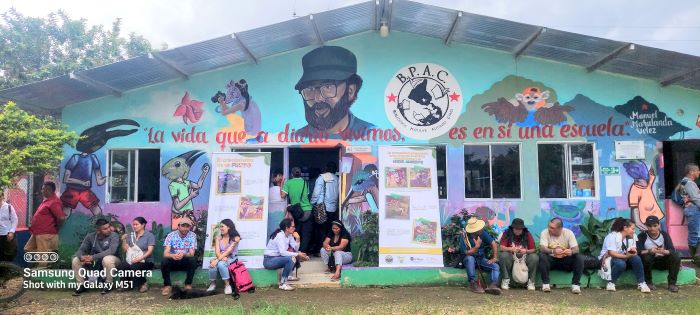
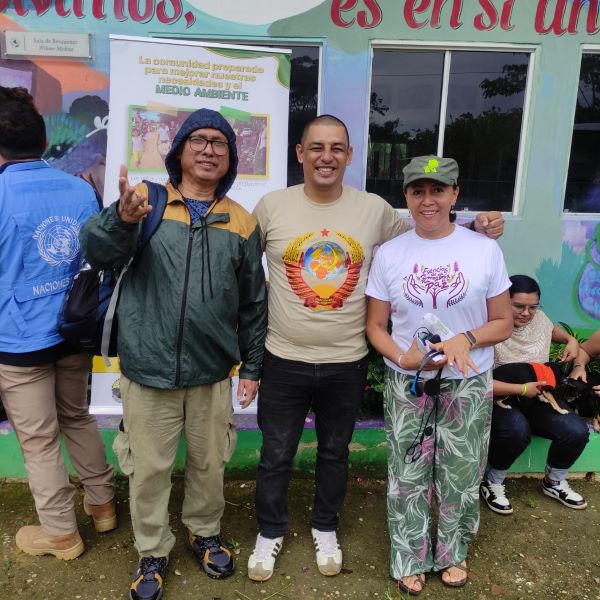
 Agua Bonita welcomed us warmly with villagers assembled in the makeshift hall where the event was being organized. The stunning beauty of the village looked defying its revolutionary past. Murals and paintings on every house wall paid tribute to commanders resembling Fidel Castro and Che Guevara, blending natural splendor with striking graffiti. The impact of the former commanders and their ideology was openly visible in the village. In an open hall, a large community gathered along with several officers of armed police as well as local leaders from the municipality as well as community elders. The events that followed were led by a confident yet concerned woman, Sandra Gonzalez Sanabria, popularly known as Betsy when she took the microphone making announcements in Spanish. Security officers outlined strict protocols, reflecting ongoing tensions. This hall served as our discussion center for three days.
Héctor Ramírez ETCR (Territorial Space for Training and Reincorporation) was established post-2016 to reintegrate former Revolutionary Armed Forces of Colombia (FARC) members into civilian life. Named after Héctor Ramírez, a FARC leader killed in the conflict, the region was a FARC stronghold in the 1990s and early 2000s. Despite the peace accord, dissident threats and violence persist, as evidenced by the heavy police presence during our visit. Without this historical context, Agua Bonita might seem like a staged showcase, but its lakes and mountains make it undeniably picturesque. The security protocol resulted in the male members of the team numbering nine, shifted to stay in secluded place about a kilometer outside the main venue but it came as a boon for all of us. The locality was stunningly beautiful surrounded by greenery and a beautiful lake. We came to know that these huts allocated to us for our stay were meant to promote eco friendly tourism for the communities living in Caquetá.
Interestingly, the community’s camaraderie defines Agua Bonita, transforming it into a beacon of peace and hope. Focusing on sustainable agriculture and ecotourism, it symbolizes a fragile yet inspiring shift from conflict to coexistence, serving as a model for reconciliation and democratic inclusion.
While the village Agua Bonita won our heart not merely because of its beauty but also the people and the community who actually taught us their philosophy of life and leading them, for this particular event was Sandra Gonzalez Sanabria, the community’s passionate leader known as Betsy among friends and colleagues locally. Born on January 14, 1979 to a peasant family in Neiva, Huila, in the Caquetá region, Sandra fled home at 12 as life became extremely difficult after her father’s disappearance during the violent clashes between revolutionaries and government forces. “My father disappeared in Neiva, Huila on February 13, 1986 when I was six,” she shared. “I consider myself an orphan due to the conflict between guerrillas and the army, where civilians were caught in the crossfire, accused by both sides.”
Sandra actually was witness to the violent suppression of the local people seeking their rights and faced the trauma in the aftermath of the sad event. It is beyond imagination how a a young girl not even in her teen, would have faced the rough weathers of life which were not really natural but totally state sponsored. Sandra’s parents worked as peasant contractors for the wealthy Lara family, who owned prime lands in Caquetá. It is a sad reality that poor people have to serve for the business interest of the powerful. FARC fighters actually had been targeting the rural landed elite and redistributing land after snatching them. Of course, for the state, it was criminal but this area remained under FARC.
During the conflict, FARC forced the redistribution of these lands to peasants. Her father’s disappearance, a victim of state repression, shattered her family. “My mother found it difficult to raise her,” Sandra recounted. “At 12, I ran away and begged FARC to take me in, as my mother could no longer cope.” Joining FARC offered her a sense of family and purpose. “Life in the guerrilla struggle was tough and austere, but we lived like a family, with reading, training, and ideology to understand the class struggle.”
Sandra’s skills extend beyond ideology. She is an Auxiliary Technician in Pharmaceutical Services and an Agricultural Technician specializing in food processing. As a leader in Agua Bonita’s reintegration process, she emphasizes collective work. “We arrived in Agua Bonita in 2017,” she said. “Over 400 former combatants settled here initially; now, 278 remain. There was 20 hectares of land but we collectively farm 10 hectares as the rest is arid terrain.” During our conversation in the village, we found the immense bond among people which is the outcome of the collectivization process. Individuality might be an acceptable phenomenon globally but it is also resulting in mindless exploitation of our resources and increasing greed to amass wealth without bothering about the others.
Sandra’s commitment to community shines through her work with children. Though she chose not to have her own, she fights for the well-being of over 25 children aged 18 months to 5 years, ensuring they receive foundational education. “What I love most about this community is the family warmth and collective spirit, despite challenges,” she said.
During our conference, children with cameras documented the event, trained in videography, photography, and editing at a local library run by the Multi-active Cooperative for Good Living and Peace in Caquetá (COOMBUVIPAC). It was wonderful to hear their narrative as how they report about the village problems and also learn about current issues and read latest books. Founded by The Commons Party, COOMBUVIPAC has 115 members engaged in farming, construction, and cooperative work for a solidarity-driven economy.
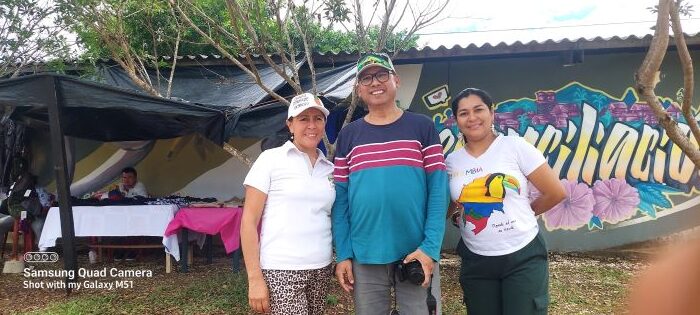
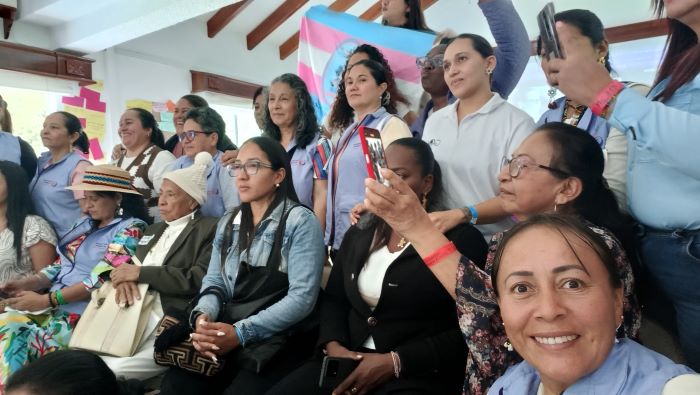 As president of the Association of Women Producers of Essence of Peace (ASMUPROPAZ), Sandra champions women’s economic autonomy through agro-food gardens, human rights, and ecosystem restoration. Active for five years, ASMUPROPAZ fosters mutual agreements for responsible land governance, benefiting families beyond its members. Sandra also serves on the municipal peace council and the Departmental Council of The Commons Party, established in 2017 to ensure former FARC members’ political participation. “I’ve led reconciliation and peace projects,” she said, “and I’m a member of the Territorial Planning Council of La Montañita.” Sandra is a woman of ideas and deep conviction who lead from the front and encourage her colleagues and sisters to enjoy the power of self-reliance and economic independence. For three days, we saw her in different activities including disturbing food, snacks and tea up to coordinating things and making arrangements for the guests.
Agua Bonita’s murals and monuments look reminiscent of left movements in Kerala, West Bengal, and Telangana, where communities honor victims of state violence. A memorial, created during the Agua Bonita Festival, reflects the community’s struggle and hope, with symbols of pineapple farming and peacebuilding. Yet, Sandra acknowledges ongoing challenges: “Repression persists from shadowy state forces. Over 450 peace accord signatories have been killed since 2016.” This is a dark reality that you cannot really make every happy with a particular decision particularly in the state who some time use these tactics to ‘rearm’ itself and act accordingly. Same is true about the dissenters who might not have liked the peace accord and still looking for a ‘Bolshevik revolution’.
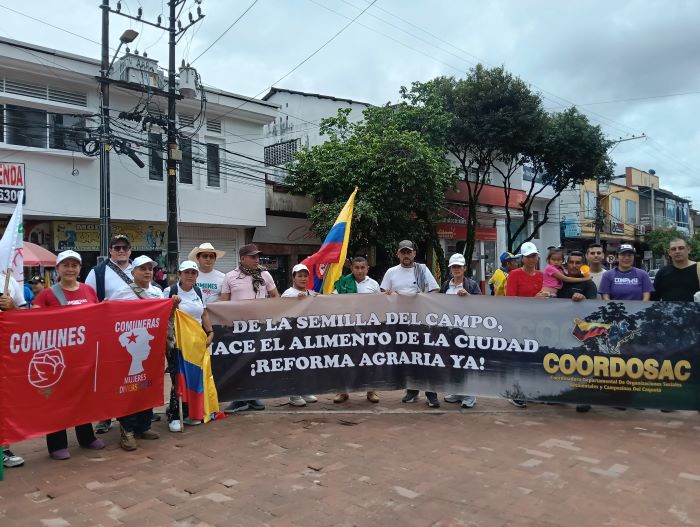
Sandra’s story underscores the importance of inclusive peace. “The 2016 peace agreement aimed to ensure a dignified life for Colombians,” she said. “I don’t oppose it, but I’m critical of its failures. It’s about the dignity of the excluded majority and caring for biodiversity.” Her words echo the frustrations of Colombia’s marginalized, challenging elite narratives and advocating for economic independence. For a person engaged with the Ambedkarite perspective, it caught my own imagination and gave me a new learning. We always said that India is ruled by the Brahmanical minority but when I read the stories of people in Latin America as well as Africa, I realise the damages that colonialism has done to these societies and that we are not alone. It has many aspects somewhere it reflects in white supremacism while we fight against Brahmanical hierarchical in India and the feudal landed Muslim elites in the Islamic societies but it is a fact that globally it is the ‘minority elite’ that rules our societies despite tall claims of ‘democracies’ and ‘rule of law’. It is not a hidden fact that post-colonial rule of law in Colombia has only established and strengthened the control of the settler elite in the country. Nevertheless, the fight against injustice continues and good thing is that common masses, native and indigenous and Bahujan communities have now understand the art of politics and governance as clearly indicated in the reflections of Sandra Gonzalez Sanabria.
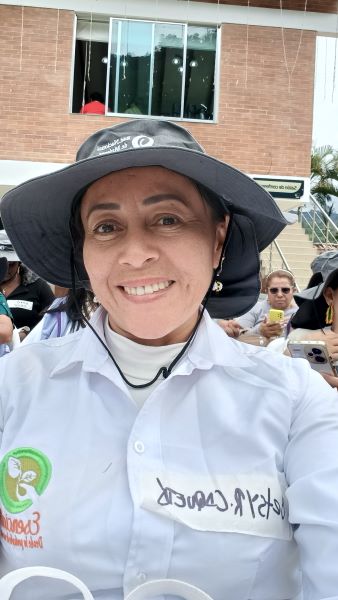
A song shared by Sandra, performed by two young people and Emilio, a peace accord signatory and artist in Agua Bonita, captures this spirit:
In the land where I was born,
where the sun embraces and the wind is harsh,
I sowed dreams with sweat and faith,
in a field where the skin grows tough.
Sowing hope, we will fight,
with heart and strength, never giving up.
For peace, for life, for a new day,
sowing hope, the future will come.
Amid bullets and broken promises,
we walk with a devoted soul.
Pain taught us to grow,
and in the struggle, we never stop believing.
In the fields, in the jungle, in the heart,
we carry the flag of redemption.
We don’t give up, we stand tall,
for a tomorrow where everyone will thrive.
Sowing hope, the future is here,
in our hands, we will make it near.
With love, with struggle, with dignity,
sowing hope, peace will arrive.
(the Transcription and translation of the audio was provided by Grok)
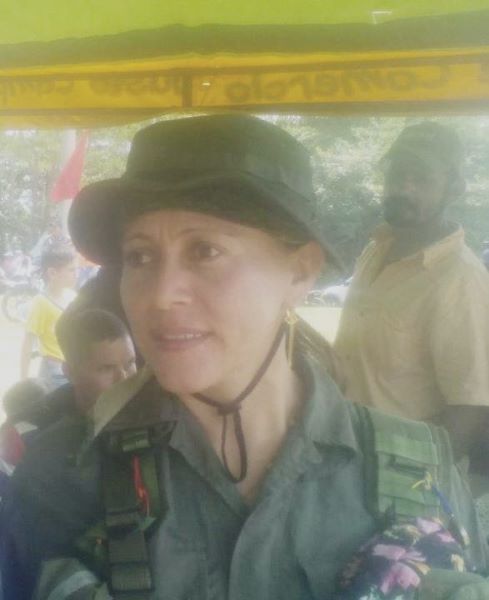
Sandra Gonzalez Sanabria proudly embraces her association with FARC and the communist movement. She states, “I am an ordinary woman, a socialist, and a proud member of the Comunes Party, also known as the Commons Party. Rooted in a social and peasant sensibility, I take pride in working alongside women deeply impacted by Colombia’s conflict—a reality I’ve lived since childhood. Many misunderstand socialism and communism. Colombia can be a patriarchal, violent, and individualistic society, yet socialism and communism are beautiful philosophies centered on prioritizing collective well-being over competition. Embracing a simple life fosters happiness through solidarity and shared purpose.”
I’m struck by Sandra’s response to my provocative question. In so-called ‘liberal democracies,’ ‘socialism’ and ‘communism’ are often vilified and dismissed as contemptible terms. In many societies both these terms are made to look even criminal and yet Sandra articulates them as a philosophy of life grounded in her experiences, something many of us struggle to do. Her political education and worldview stem from the practical realities of her surroundings, offering a perspective more authentic than uninformed critiques.
Sandra’s journey—from a childhood marked by conflict to a leader advocating for peace and empowerment—mirrors the transformation of Agua Bonita. Her story challenges elite narratives and calls for global solidarity among oppressed communities to rewrite their histories and build a future rooted in dignity and justice. A big salute to Sandra Gonzalez Sanabria.