
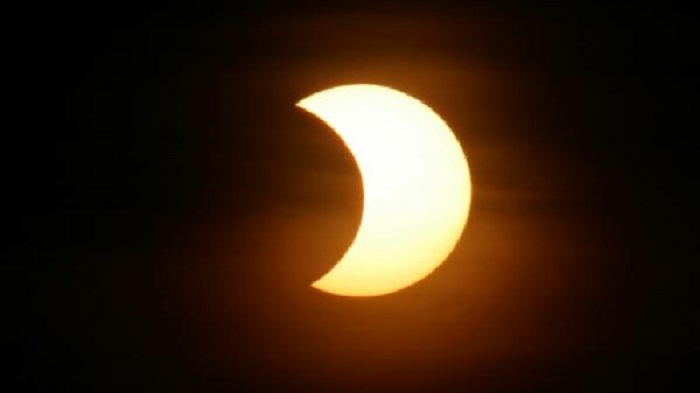

(Samajweekly) The world is going to witness a spectacular celestial event on the eve of 2 August 2027. Now the question is that what is so special about this solar eclipse? Well the answer to the above question is that this would be a special total solar eclipse and would last up to duration of 6 minutes and 23 seconds. Another memorable part of this Solar eclipse would be that this will be the longest eclipse visible from land since 1991 and no longer one will occur until 2114 !!!!
The main reason for the long duration of solar eclipse lies in the perigree position of moon, the position when moon is at closest point to Earth. At this special position the Moon is able to completely cover the Sun revealing the breathtaking solar corona.
A total solar eclipse occurs when the Moon passes directly between Earth and the Sun’s path fully obscuring the Sun’s disk for a brief period in regions within the narrow path of totality. this total solar eclipse happens every 18 month somewhere on the earth having different time duration.The upcoming solar eclipse which is due to happen on August 2, 2027, is particularly notable due to its extraordinary duration with favorable viewing locations and potential for scientific exploration.
Astronomical Mechanics Behind the Eclipse
The eclipse’s unusual length is primarily due to two key orbital phenomena:
a. Lunar Perigee
On August 2, 2027, the Moon will be near perigee, its closest point to Earth (approximately 356,000 km away). This makes the Moon appear slightly larger in the sky allowing it to cover the Sun completely for a longer period.
b. Earth’s Aphelion
The event also occurs near Earth’s aphelion (farthest distance from the Sun), which typically happens in early July. At this time, the Sun appears slightly smaller in the sky, further contributing to the extended eclipse duration.
These combined effects result in a totality phase that can last up to 6 minutes and 23 seconds — well above the average of 2–3 minutes for most total eclipses.
Geographic Path and Visibility
The path of totality is a narrow strip which is roughly 250 km wide where observers will experience full darkness during totality. The eclipse will traverse multiple regions offering viewing opportunities to millions of people across several continents.Regions as far as Southern Europe, Western Asia, and Northern Africa will witness a partial eclipse depending on proximity to the path.
Scientific Opportunities
The Total solar eclipses provide rare chances to humanity specially having scientific hunger for observing those parts of the Sun that are typically obscured under normal circumstances.
a. Solar Corona Studies
The solar corona — the Sun’s outer atmosphere — which becomes visible only during totality. Scientists throughout the globe can study its magnetic structure, temperature and dynamics which can contribute to better understanding of solar winds and space weather.
b. Helioseismology and Magnetic Fields
Precise eclipse measurements can help in the study of the magnetic field lines, sunspots and solar oscillations enhancing models of solar behavior.
General Relativity
Historically eclipses were used to test Einstein’s theory of general relativity. Though modern tools are more precise eclipses still serve educational and symbolic roles in physics demonstrations.
Cultural and Tourism Impact
In regions like Luxor, Egypt which will experience the maximum duration, tourism is expected to surge. Eclipses have long inspired awe and fascination, blending scientific curiosity with cultural traditions. Nations along the eclipse path are preparing for significant public engagement, scientific collaborations and media coverage.
Safety Precautions
Observers must use certified solar eclipse glasses or indirect viewing methods during all partial phases. Looking directly at the Sun without proper protection can cause permanent eye damage. Only during the brief period of totality is it safe to view the eclipse with the naked eye.
Future Prospects
The last eclipse of similar magnitude has occurred in 1991 (lasting 6 minutes 53 seconds, visible across the Pacific).
The next eclipse exceeding this one in duration will not occur until June 13, 2132, with a maximum of 6 minutes 55 seconds.
For most people alive today, August 2, 2027, represents a once-in-a-lifetime opportunity to witness a long-duration total solar eclipse.
The 2027 total solar eclipse is more than a breathtaking natural phenomenon — it is a global scientific event, a cultural moment, and a reminder of humanity’s place in the cosmos. With proper planning, education, and safety, this event can inspire the next generation of scientists, explorers, and dreamers.
SURINDERPAL SINGH
SCIENCE CORRESPONDENT
FACULTY IN SCIENCE DEPARTMENT
SRI AMRITSAR SAHIB
PUNJAB