SAMAJ WEEKLY UK
Socialism and Secularism—No Wounds: The Incomparable Historical Legacy, Integrity, and Democratic Foundations of the Republic: An Appraisal

Dr. Ramjilal, Social Scientist, Former Principal, Dyal Singh College, Karnal (Haryana-India)
Email—[email protected]
India is a great democratic, secular, socialist, and independent nation. India is incredibly diverse in terms of religion, caste, culture, region, ethnic group, mother tongue, and sects. In terms of population, India has a population equal to the total inhabitants of almost 100 states. According to the 2011 census, India has followers of eight different religions: Buddhism (0.7%), Jainism (0.4%), Sikhism (1.7%), Islam (14.2%), Christianity (2.3%), Hinduism (79.8%), and other religions, including Judaism and Zoroastrianism (0.7%). India has an estimated 200 ethnic groups, 7,000 castes, and 80,000 sub-castes, including 5,013 backward classes, 730 scheduled tribes, and 1,108 scheduled castes (Census 2011). In terms of linguistic diversity, the Eighth Schedule of the Indian Constitution lists 22 officially recognised languages. Besides these, there are 270 mother tongues and over 121 native languages. According to some other sources, over 1652 languages or dialects are spoken as mother tongues. What we are trying to say is that India’s rich, cultural, and historical heritage includes its religious and linguistic diversity. Since the dominance of the majority religion cannot be used to rule the country, the Indian Constituent Assembly has adopted the idea of unity in diversity. Secularism is the basis of Indian unity, integrity, and incomparable historical heritage. The foundation of socialism also lies in ancient Indian culture. The famous Sanskrit text “Brihadaranyaka Upanishad” says, “Sarve Bhadrani Pashyantu, Ma Kashchid Dukhbhagbhavet. (“सर्वे भद्राणि पश्यन्तु, मा कश्चिद् दुःखभाग्भवेत्.” -बृहदारण्यक उपनिषद) The wish for human welfare, a happy, healthy, disease-free life, peace, and well-being is clear in this verse. It is unfair for those who oppose socialism to disregard Indian culture because it serves their own interests.
The golden legacies of the Indian freedom movement include socialism and secularism. From the revolutionary freedom movement to the present, socialism and secularism have been the central concerns of mass movements. Karl Marx’s scientific socialism and the Russian socialist revolution also influenced the thoughts of Ashfaqulla Khan, Shaheed-e-Azam Bhagat Singh, Rajguru, Sukhdev, Chandrashekhar Azad, Shaheed-e-Azam Udham Singh, and other revolutionaries. Revolutionary Udham Singh, who changed his name to “Ram Mohammad Singh Azad,” is one of the best examples of secularist ideology. The name is the ultimate symbol of Hindus, Muslims, and Sikhs, unity, and freedom for Sikhs. In 1928, Bhagat Singh, Sukhdev Thapar, and other revolutionaries renamed the Hindustan Republican Army (HRA) as the Hindustan Socialist Republican Association.
The legacy of socialism and secularism in India was largely propagated by communist leaders—M.N. Roy, S.A. Dange, Shaukat Osmani, G. Adhikari, P.C. Joshi, Muzaffar Ahmed, S.V. Ghate, P. Sundarayya, E.M.S. Namboodiripad, Jyoti Basu, and Harkrishan Singh Surjeet. Socialist leaders like Dr. Ram Manohar Lohia, Jayaprakash Narayan, and Acharya Narendra Dev have played an important role in promoting both socialism and secularism. The Congress Party too saw socialism and secularism as the cornerstone of national unity in the national movement. Mahatma Gandhi, Jawaharlal Nehru, Subhash Chandra Bose, Smt. Indira Gandhi, and now the Leader of the Opposition in the Lok Sabha, Rahul Gandhi, and other Congress leaders have a special place for socialism and secularism in their bent of mind. Dr. Bhimrao Ambedkar’s philosophy was based on secularism. In his writings, he has criticised the state that practices a majority religion.
On the basis of socialist ideas, workers, farmers, women, and students were mobilised against feudalism, capitalism, and exploitation by organisations such as the All India Kisan Sabha (1936), the All India Students Union (1936), the Students Federation of India (SFI) (30 December 1970), the Democratic Women’s Association (AIDWA) (1981), and others.
The Constituent Assembly’s Debates: Secularism and Socialism
Discussions on socialism, secularism, and other topics became clearly visible after Jawaharlal Nehru presented the Objective Resolution in the Indian Constituent Assembly on December 13, 1946. On December 6, 1948, the Indian Constituent Assembly held extensive discussions on many topics related to freedom, religion, and secularism. Dr. Bhimrao Ambedkar, Jawaharlal Nehru, S. Radhakrishnan, Loknath Mishra, A. Nagappa, H. V. Kamath, Pandit Thakurdas Bhargava, Frank Anthony, Mohammed Ismail Saheb, Tajamul Hussain, Mrs. Durgabai, L. Krishna Swami Bharati, Rohini Kumar Chaudhary, T. T. Krishnamachari, Pandit Lakshmikant Maitra, Alladi Krishna Swami Iyer, and others participated in this discussion. HC Kamath, SL Saxena, Pandit Madan Mohan Malaviya, and others said that the Preamble of the Constitution should begin with the name of “God”. Professor KT Shah had suggested on November 15, 1948, that India be called a “Union of Secular, Federal, Socialist States” in Clause 1 of Article 1 of the Indian Constitution, as mentioned in the seventh volume of the proceedings of the debate. Dr. Rajendra Prasad, the chairman of the Constituent Assembly, requested H.V. Kamath to drop the “God” motion, but he refused. The Constituent Assembly voted down “God,” “Socialism,” and “Secular” all by rejecting them.
Dr. Bhimrao Ambedkar objected to the addition of the word socialist and said that the next generation of Indians would decide whether the country’s top priority should be capitalism or socialism.
The opposition to socialism was further justified by the fact that the principles of the socialist system are mentioned in the Articles (38, 39, 40, and 41) listed in the fourth chapter of the Indian Constitution. The opposition to the secular state was made with much the same argument: that the principles of the secular state are enshrined in the fundamental rights listed in Chapter III of the Indian Constitution, particularly Articles 14, 15, 16, 25 to 28, 29, and 30. In other words, India is not a religious state. Despite this, Ambedkar was not opposed to secularism. In the Constituent Assembly, in “Socialist Republic”, Ambedkar said about socialism, “I regret that I cannot accept the amendment of Prof. K.T. Shah,” while he was not against secularism. As a result of his two main complaints:
In his inaugural address, Ambedkar defended his proposal before the House, saying that the Constitution is merely a means of regulating the actions of the various branches of government. What social and economic structures should society have, and what policies should the state implement? These choices have to be made by individuals themselves according to circumstances and times. If this were incorporated in the Constitution, democracy would be completely undermined.
Second, despite the fact that the word “secular” was not used in the original Preamble of the Constitution, Dr. Bhimrao Ambedkar was not against a secular state because he opposed the two-nation theory, the idea of Hindu Raj, the partition of India, and the creation of Pakistan. He stated, ‘My honourable friend Prof. Shah did not acknowledge that we have included fundamental rights in the Constitution, but we have also added other clauses relating to the Directive Principles of State Policy. I argue that this amendment is totally unnecessary because our Constitution already incorporates these socialist principles’.
The main objective of the Rashtriya Swayamsevak Sangh, the Bharatiya Janata Party, and other affiliated organisations is to create a Hindu nation, which is completely at odds with the social justice, equality, liberty, and fraternity that Bhimrao promotes. Dr. Bhimrao Ambedkar’s revised book “Thoughts on Pakistan” states that the establishment of Pakistan would be a great tragedy for all of us because it would allow Hindu rule to enslave the Dalits.
The Indian Constitution, democracy, equality, liberty, fraternity, social justice, and nation-building would all be destroyed if Pakistan or Hindu Rashtra were founded on religious grounds, Dr. Bhimrao Ambedkar argued in his revised book “Thoughts on Pakistan.” He believed that it was wrong to establish a nation based only on religious beliefs, and he opposed Hindu Raj because he believed it threatened national progress, democracy, and the Indian Constitution.
If Hindu Raj becomes a reality, it will undoubtedly be the greatest misfortune of this country. Whatever the Hindus may say, Hinduism is a threat to liberty, equality, and fraternity. It is incompatible with democracy. Hindu Raj must be prevented from being established at any cost.” (Dr. B.R. Ambedkar, Thoughts on Pakistan, Writings and Speeches, Vol. 8, p. 358). He further writes that “There is no doubt that caste is essentially the soul of the Hindus. But the Hindus have polluted the whole environment, and the Sikhs, Muslims, and Christians all are suffering from it…. The supporters of Hindu supremacy knew that democracy could be used to establish Hindu Raj. They and their followers want to use the Hindutva card to vote for power.” Ambedkarism is against majoritarianism, which in the Indian context means unbridled rule by the majority community—the Hindus. Ambedkar wrote on March 24, 1947, in a memorandum on the rights of the states and minorities, which he submitted to the Sub-Committee on Fundamental Rights constituted by the Consultative Committee on Fundamental Rights, Minorities, etc., of the Constituent Assembly: “Unfortunately for the minorities in India, Indian nationalism has evolved a new theory which may be called the divine right of the majority to rule over the minorities according to the wishes of the majority. Any claim by the minority to share power is called communalism, while monopoly of the entire power by the majority is called nationalism. Inspired by such a political philosophy, the majority is not prepared to give a share in political power to the minorities.” (B. Siva Rao, Selected Documents, Vol. 2, p. 113).
According to Ambedkarism, the political ideology based on Hinduism is totally anti-democratic, fascist, and anti-national. It is a Nazi ideology. In the words of Dr. Bhimrao Ambedkar:
“Hinduism is a political ideology that is completely anti-democratic and whose character is similar to fascism or Nazi ideology. If Hinduism gets a free hand—and this is what it means to be in the majority with Hindus—then it will not allow those people to progress who are not Hindus or are against Hinduism. This is not only the view of Muslims. It is also the view of the oppressed classes and non-Brahmins.” Giving a historical example in the Constituent Assembly, he said that “Betrayal by insiders is our old enemy, while our new enemy is caste and religion. If people do not put the nation above their religion and caste, our freedom will be lost again. “ According to Newton’s law of motion, every action has an equal and opposite reaction. Ambedkarism warns us that if the theory of Hindu Rashtra or Hindu Raj continues to grow, then according to the law of motion, we may reach the dangerous situation of 78 years ago. It is absolutely necessary to stop this.
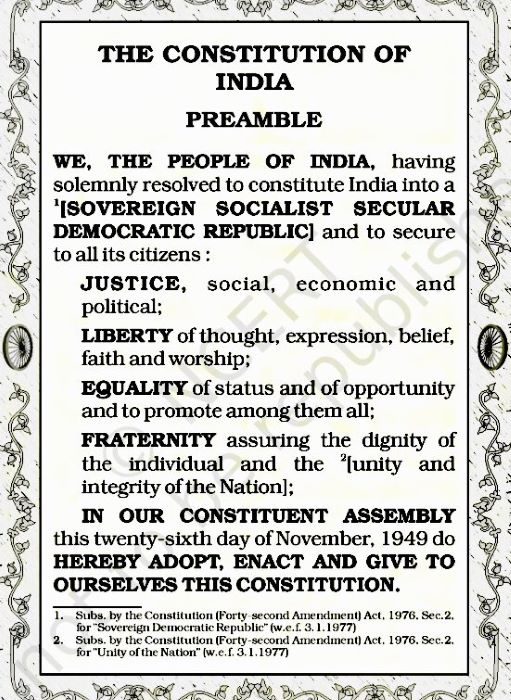
The Preamble to the Indian Constitution:
WE, THE PEOPLE OF INDIA, having solemnly resolved to constitute
India into a SOVEREIGN SOCIALIST SECULAR DEMOCRATIC REPUBLIC
and to secure to all its citizens:
JUSTICE, social, economic and political;
LIBERTY of thought, expression, belief, faith and worship;
EQUALITY of status and of opportunity;
and to promote among them all
FRATERNITY assuring the dignity of the individual and the unity and integrity of the Nation;
IN OUR CONSTITUENT ASSEMBLY this twenty-sixth day of November, 1949, do HEREBY ADOPT, ENACT AND GIVE TO OURSELVES THIS CONSTITUTION.
The recommendations of the S. Swarn Singh Committee
During the era of emergency, an 11-member committee headed by S. Swarn Singh was formed in 1976. This committee proposed the following changes to the Indian Constitution’s preamble:
First, the words “secular,” “socialist,” and “integrity” should be added to the preamble of the Constitution.
Second, it was proposed to add 10 fundamental duties to the Directive Principles of State Politics, the fourth chapter of the Indian Constitution, which was amended to include Chapter 4A and Article 51A. After the 86th amendment in 2002, the number of fundamental duties was raised to 11.
All the Congress Party’s chief ministers, state presidents, members of parliament, the Supreme Court’s Bar Council, the Bar Councils of some High Courts, the public, and newspapers discussed these, despite the fact that all of the opposition party leaders were imprisoned during the emergency. Memoranda were also received, and after much discussion, they were incorporated into the Constitution. There were no references to “socialist,” “secular,” or “integrity” in the original constitution’s preamble. These three words were added to the preamble by the 42nd Amendment during the emergency of 1976. Under the direction of Morarji Desai’s Janata Party central government, the 44th amendment was ratified in 1978. Several articles of the 42nd Amendment were altered by this amendment. Nevertheless, the words “socialist,” “secular,” “integrity,” and “fundamental duties” that were added to the constitution’s preamble were kept.
We would like to draw the attention of the readers to the fact that in 1978, Atal Bihari Vajpayee and Lal Krishna Advani were cabinet ministers in the central government of the Janata Party.
The Argument Over “Socialist” and “Secular”: The Beginning
MS Golwalkar (popularly known as Guruji), who was the head of RSS for 43 years (1940-1973), was a leading ideologue of militant Hinduism and a strong supporter of Hindu Raj, Hindu Rashtra, and Hindu culture. Being a vibrant ideologue of Hinduism, he advocated the inclusion of minorities in Hindu culture and called upon them to glorify Hindu culture. It can be highlighted, therefore, that MS Golwalkar was adamantly opposed to secularism. The RSS ideologue, MS Golwalkar, was thoroughly a strong critic of communism and communists, and the slogan was raised, ‘No Socialism but Hinduism.’ In a nutshell, RSS opposes both socialism and secularism.
Therefore, it can be underlined that MS Golwalkar was a staunch opponent of both socialism and secularism. The basic agenda of the Rashtriya Swayamsevak Sangh is to create a Hindu nation based on Manuism -Manasmriti; it can be proved based on the following historical chronology. Constitution of India On 26 November 1949, the Constitution was ‘adopted, enacted, and dedicated’ in the Constituent Assembly. But four days later, RSS’s flagship newspaper, The Organiser, in its editorial on 30 November 1949, criticised the constitution and wrote, “The most important thing about the new constitution of India is that it has nothing that can be called Indian. It has neither Indian laws nor Indian institutions nor Indian vocabulary and terminology.”
In 1937, Vinayak Damodar Savarkar (VD Savarkar), the elected president of the All India Hindu Mahasabha, propounded the two-nation theory based on the idea of a Hindu nation. Considering Manusmriti as the root of Indian culture and Hindu law for the creation of a Hindu nation based on the two-nation theory, he wrote, “Manusmriti is the scripture that is most revered for our Hindu nation after the Vedas. For centuries, this book has codified the spiritual and divine journey of our nation. Even today, the rules that crores of Hindus follow in their lives and behaviour are based on the Manusmriti. Today, the Manusmriti is Hindu law. This is the root.”
RSS Sarsanghchalak K. Sudarshan said in 2000 that the Indian Constitution is based on Western values, and it should be removed and replaced with a constitution based on Hindu holy texts (i.e., Manusmriti). In short, the RSS opposes both socialism and secularism.
But this background contrasts sharply with the right-wing ideologies of the Bajrang Dal, Vishwa Hindu Parishad, Rashtriya Swayamsevak Sangh, and others criticising India’s secularism. Terms like “canker,” “minority appeasement,” “political opportunism,” “pseudo-secularism,” and others are increasingly being used to try to unite the adherents of Hinduism and put an end to secularism by advocating for the creation of Hindu Rashtra. They still support state governance on the grounds that Hinduism is superior, and they continue to promote secularism as pseudo-secularism, which is antagonistic to Indian culture and supported by Western ideology.
In the 2024 Lok Sabha elections, 36.5 percent of the vote went to the Bharatiya Janata Party. In other words, 63.5% of voters disagreed with the Bharatiya Janata Party’s Hindu Rashtra tenet. The BJP and Rashtriya Swayamsevak Sangh are concerned that the NDA’s constituent parties will rebel, denying the Bharatiya Janata Party power and hindering its ability to implement the Hindu Rashtra agenda, if the upcoming elections result in a low vote percentage and fewer seats in the Legislative Assemblies and Lok Sabha.
We would like to draw the readers’ attention to the fact that in 1978, Atal Bihari Vajpayee and Lal Krishna Advani were cabinet ministers in the Janata Party’s central government.
Further, the Ministry of Social Justice and Empowerment announced on November 19, 2015, that the Government of India has decided to celebrate November 26 as ‘Constitution Day’ in line with the announcement of Prime Minister Narendra Modi. In an effort to increase public awareness about constitutional principles, November 26 has been officially recognised as “Constitution Day” every year since 2015. In 2019, an initiative was launched to raise public awareness about the 11 fundamental duties listed in Chapter 4A (Article 51A) of the Constitution.
However, the Bajrang Dal, Vishwa Hindu Parishad, Rashtriya Swayamsevak Sangh, and other right-wing ideologies that oppose India’s secularism are entirely distinct from this background. Words like “canker,” “minority appeasement,” “political opportunism,” “pseudo secularism,” and others are being used more and more to rally Hindus and put an end to secularism by calling for the establishment of a Hindu nation. They continue to promote secularism as pseudo-secularism, which is opposed to Indian culture and backed by Western ideology, and they still defend state rule with the primacy of Hinduism.
In the 2024 Lok Sabha elections, the Bharatiya Janata Party emerged victorious, with 36.5 percent of the votes. In other words, 63.5% of voters opposed the Hindu Rashtra ideology and pro-corporate policies of the BJP. If the upcoming elections result in a low vote percentage and fewer seats in the assemblies and the Lok Sabha, the BJP and the RSS are both afraid that the NDA members will rebel. Consequently, the BJP would lose power and have a harder time carrying out the Hindu Rashtra agenda.
Socialism
One of the most significant principles of the Indian Constitution is socialism. The 42nd Amendment to the Constitution added the word “socialism.” However, the term “socialism” gradually vanished from Indian political grammar after 1991. Instead of socialism, capitalism is being pushed on the grounds of globalisation, corporatisation, privatisation, and liberalisation. The centralisation of wealth causes the rich to get richer and the poor to get poorer, according to Karl Marx’s theory of surplus value. A tiny number of billionaires control the majority of the nation’s wealth, and the number of people living in poverty keeps rising. This encompasses the entire Indian political system. A large amount of India’s wealth is controlled by a few capitalists, and the gap between the rich and the poor is growing. According to Oxfam’s report on inequality in India, the country has the highest concentration of wealth in the hands of a few billionaires globally. The richest 1% of Indians own 40.1% of the country’s wealth and 22.6% of its income, according to the Oxfam India (2023) report. In addition, 72% of the nation’s wealth and 57% of its income are owned by the top 10% of billionaires. However, only around 3% of India’s wealth is owned by the poorest 50% of its population. The BJP and the Rashtriya Swayamsevak Sangh back pro-corporate initiatives like globalisation, privatisation, and liberalisation.
In light of this, Dattatreya Hosabale, the general secretary of the RSS, has caused controversy with his statement. During the Emergency in 1976, the terms “socialist,” “secular,” and “integrity” were added to the Indian Constitution’s Preamble, said RSS general secretary Dattatreya Hosabale at a celebration of the Emergency’s 50th anniversary at the IGNCA in New Delhi. These words were not in the original preamble. He asked, “Are these words still relevant today?”
At a book launch event in New Delhi, India’s vice president, Jagdeep Dhankhar, declared that the Preamble of the Constitution is “not changeable.” ,” since it is the “seed” that the document is constructed upon. He claims that only the preamble of the Indian constitution has been altered. and the terms “socialist,” “secular,” and “integrity” were added. He emphasised “But this preamble was changed by the 42nd Constitutional (Amendment) Act of 1976.” “Socialist” and “secular” have been vehemently described by the vice president as a “canker” and a “travesty of justice.” Those who support Dattatreya Hosabale include Vice President of India Jagdeep Dhankhar, Agriculture Minister of India Shivraj Singh Chauhan, Jitendra Singh, BJP MP Praveen Khandelwal, RSS thinker and former Rajya Sabha member R.K. Sinha, etc.
It is a very surprising and funny situation that the persons in power who take an oath to protect the Constitution while assuming office are the ones who question the relevance of the words “socialism” and “secular” included in the preamble of the Constitution, calling them inappropriate and unnecessary.
The words “secular” and “socialist” in the Preamble of the Indian Constitution are deemed meaningless by those who agree with RSS General Secretary Dattatreya Hosabale.. In contrast, Section 2 of the Constitution and Rules of the Bharatiya Janata Party (September 2012) outlines the party’s goals and declares that the party “shall bear true allegiance to the Constitution of India as by law and to the principles of socialism, secularism, and democracy.” This section also uses terms like “positive secularism—equal respect for all religions,” “Gandhian approach,” “establishment of an exploitation-free and egalitarian society,” etc. We firmly believe that everything said by RSS General Secretary Dattatreya Hosabale is against the goals of the Bharatiya Janata Party as outlined in Section 2 of its Constitution and Rules (September 2012), as well as the spirit of the Indian Constitution. The key issue is whether the Bharatiya Janata Party will act against these leaders for criticising its own constitution.
The statements made by Dattatreya Hosabale are implicitly supported by the silence of the three main Bharatiya Janata Party leaders: Amit Shah, the Home Minister; Narendra Modi, the Prime Minister of India; and JP Nadda, the National President of the BJP. In a press conference following Dattatreya Hosabale’s statement, however, former bureaucrat-turned-politician External Affairs Minister S. Jaishankar stated, “I am a minister of the government, so it is not appropriate for me to comment on such a matter.” The BJP-led NDA’s constituents’ silence, however, is what is most unexpected.
The opposition parties’ reaction: From Rahul Gandhi, the leader of
The opposition in the Lok Sabha, to Dipankar Bhattacharya, the opposition
The opposition parties have strongly condemned Hosabale’s remarks. Senior Congress leader Jairam Ramesh and Congress Party leader and Leader of the Opposition in Lok Sabha Rahul Gandhi have criticised Hosabale’s remarks as inspired by “Manuvad.” Along with these leaders, Aam Aadmi Party, Samajwadi Party leader Akhilesh Yadav, and Trinamool Congress leader and West Bengal Chief Minister Mamata Banerjee have also strongly criticised it.
The ideology of RSS, the parent organisation of the Bharatiya Janata Party, is completely against secularism and ‘communism’ and ‘communists,’ because RSS gives priority to Hinduism and not socialism. This fact is confirmed by the slogan coined by MS Golwalkar. ‘Not socialism, Hinduism.’ This is why Hosabale’s remarks have been criticised most strongly by left-wing parties. Hosabale’s remarks on the removal of the words “socialism” and “secularism” from the Preamble of the Constitution have been termed an “attack on the fundamental values of India.” M.A. Baby, general secretary of the Communist Party of India (Marxist) claims that Hosabale’s remarks expose the RSS’s “agenda” to amend the Constitution and replace the secular democratic republic with a “Hindu nation.” D. Raja, general secretary of the Communist Party of India, called Hosabale’s remarks an “attack on the spirit of the Constitution” and accused the RSS of establishing a “theocratic state.” Dipankar Bhattacharya, general secretary of the CPI (Marxist-Leninist) Liberation, has strongly criticised the BJP and the RSS, accusing them of being fundamentally against all constitutional republican symbols, such as “sovereignty” and “democracy.”
‘Socialism and Secularism’ in Preamble: Landmark Judgments of the Indian Supreme Court
The Indian Supreme Court has given several judicial judgments in the context of the Preamble from 1973 to 2025. Secularism and socialism were added to the Preamble of the Constitution in 1976. However, in a landmark judgement in the case of Kesavananda Bharati vs State of Kerala (1973), a 13-judge bench of the Supreme Court held the Preamble to be an essential component of the Constitution three years earlier. The secular character of the State, according to which the State shall not discriminate against any citizen on the basis of religion, cannot be abolished. In other words, the Indian Constitution’s commitment to secularism is immutable. The Supreme Court established the basic structure (cornerstone) of the Indian Constitution in this judgement.
In the 1994 case of R.C. Paudyal vs. Union of India, the Supreme Court held that secularism signifies the government’s dedication to treat all religions equally. The Supreme Court elaborately outlined the implications of secularism in the Indian context in the 1994 case of M. Ismail Farooqui vs. Union of India. In the Ayodhya-Babri case (2019), a five-judge bench of the Supreme Court also examined secularism as the foundation of the Constitution. Furthermore, in its judgement in the Secularism Dispute (2024), the Supreme Court supported secularism. In short, according to all these decisions of the Supreme Court, secularism is the cornerstone and essential component of the structure of the Indian Constitution.
In its judgement on the Emergency Amendments in the case of Minerva Mills vs. Union of India (1980), the Supreme Court said, “We have resolved to be a socialist state with the responsibility of ensuring social, economic, and political justice for our people.” As a result, we have incorporated the Directive Principles of State Policy in Chapter Four of our Constitution, which outline the fulfilment of socialist objectives.
In the landmark judgement of Dr. Balram Singh and others vs. Union of India (2024), a bench headed by Chief Justice Sanjiv Khanna dismissed all PILs challenging the use of the words “secular” and “socialist” in the Preamble of the 42nd Amendment of the Constitution. In other words, the words “socialist” and “secular” will continue to be inviolable in the Preamble of the Constitution.
In short, we are aware that the omission of socialism and secularism from the Preamble is a grave threat to the integrity and unity of the nation. “Socialism” and “secularism” are inseparable historical legacies that form the foundation of the secular, socialist, sovereign, democratic Republic of India and the integrity of the country. Since socialism is the only option that can reduce the growing wealth gap created by the concentration of wealth, as a result of globalisation, privatisation, and liberalisation (LPG), it is far more relevant than corporatism and neoliberalism in the twenty-first century.