SAMAJ WEEKLY UK
By Vidya Bhushan Rawat*
The people of this country must be far more careful the next time someone invokes Gandhi and sits on a fast for a public cause. It is important not to elevate every protester into a Gandhi or a Bhagat Singh. Time and again, people have been betrayed because Gandhism itself has often been used as a tool to manage contradictions and confuse public opinion. It is also a fact that fasting has historically been a practice associated with dominant castes, and not the political path of Ambedkar, Phule, or Periyar.
Fasting may be meaningful for some, but it carries a very different significance for millions of others who remain hungry every day. Millions survive on government subsidies simply to end their daily hunger. For communities such as the Mushahars, Doms, Kols, and many others who struggle for survival every single day, fasting does not hold the same symbolic value. More importantly, would the nation respond to their fasts with the same urgency that it is displaying now?
The other day, a friend from the Safai Karmachari community asked me whether they too could organize a similar sit-in at Jantar Mantar. He was confident that gathering 5,000 people would not be difficult. I told him, however, that politicians would hardly care about their issues. Neither the mainstream media nor many self-proclaimed revolutionaries have consistently stood with India’s most marginalized communities.
Even in these gatherings, the issues are often oversimplified. The moment caste and reservation enter the discussion, many so-called revolutionaries or members of Gen Z quietly disappear. It is not true that this generation has overcome the caste crisis. Far from it. The BJP understands these contradictions very well and has repeatedly used them to its political advantage. Already, there are murmurs suggesting that the demand for Dharmendra Pradhan’s resignation is linked to his belonging to the Kurmi community. Whether true or not, caste narratives are quickly mobilized for political purposes. Time and again, the BJP has successfully capitalized on such contradictions after mass movements.
One positive aspect of the current movement is that Dalits, particularly Ambedkarites, have supported it from the very beginning, despite the fact that these protests are still not as inclusive as they ought to be.
Sonam Wangchuk has now ended his fast by drinking juice offered by two ministers at Medanta Hospital. From the very beginning, Wangchuk and his wife were uncomfortable with his treatment at Safdarjung Hospital and consistently sought his transfer to Medanta in Gurugram. This detail may have escaped many observers, but it clearly reflected his lack of confidence in a government hospital. We all know who can afford treatment at Medanta. Ideally, Wangchuk could have ended his fast at Jantar Mantar alongside the students and other protesters, but he chose otherwise. Nevertheless, it is good that he has ended his fast. He has played his role, and one hopes that he will now respect the collective will of the students rather than seek to impose his own.
Wangchuk undoubtedly inspired thousands of young people and gave the Cockroach Janata Party (CJP) greater legitimacy. However, the movement has now spread across the country. While many students initially responded to the CJP’s call, it is equally true that a large section of them have developed considerable goodwill toward Rahul Gandhi. They have rejected suggestions that Rahul Gandhi merely attempted to derive political benefit from the movement. In fact, Sonam Wangchuk’s wife’s attempt to downplay Rahul Gandhi’s protest outside the Prime Minister’s residence has been criticized by many young protesters.
It is important that students maintain an independent movement, but they should not ignore the political support extended by opposition parties. The issue of NEET has long been central to Tamil Nadu’s politics, where former Chief Minister M. K. Stalin has consistently demanded the abolition of NEET. Many others are also calling for the complete dismantling of the National Testing Agency (NTA). The real issue extends beyond one examination. It reflects the deeper crisis that this government has created within India’s education system.
Have we not witnessed the systematic dismantling of our universities and educational institutions over the past decade? Consider the circulars issued by the University of Delhi and Jawaharlal Nehru University asking students to refrain from participating in the protests at Jantar Mantar. These universities historically led not only student movements but also broader democratic struggles. Today, the government has severely curtailed that democratic space. What kind of students are we creating if they are no longer encouraged to think independently or make informed decisions for themselves?
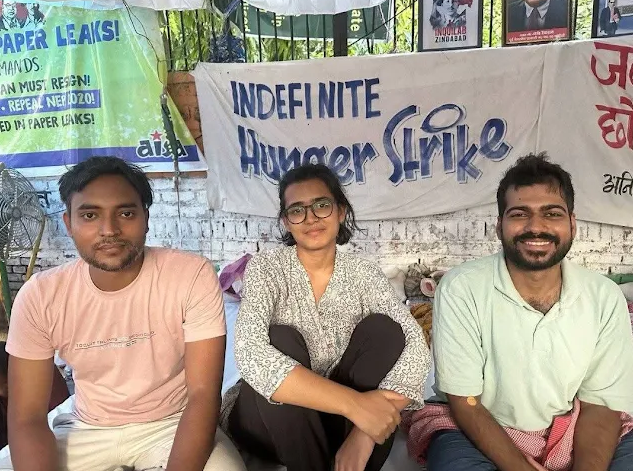
Left parties and their student organizations have been participating in these protests from the beginning. Yet the media often presented the movement as though Sonam Wangchuk alone represented it, apart from the CJP. The reality is that the movement has been sustained through the pragmatic organizational work of left parties and their student organizations. Neha Bora, President of the All India Students’ Association (AISA), along with her colleagues, has emerged as one of the most dedicated and principled leaders of this movement, displaying remarkable clarity and commitment.
Similarly, the consistent support extended by Ambedkarite leaders, including Prakash Ambedkar and Chandrashekhar Azad, deserves proper acknowledgment. The participation of both Left and Ambedkarite organizations has perhaps been the most uncomfortable aspect of this movement for sections of liberal and Brahmanical secular opinion. Yet one encouraging development over the past fifteen years has been the growing realization that greater political transformation is possible if Left and Ambedkarite forces work together.
Instead of endlessly revisiting past differences and blaming one another, these forces should engage with the pressing challenges facing the nation: communalism, crony capitalism, and the growing assault on constitutional democracy.
On the issue of NEET and the NTA, I wholeheartedly support the long-standing position of M. K. Stalin in demanding the dismantling of both institutions. Prakash Ambedkar and several Ambedkarite organizations have voiced similar demands. India requires a comprehensive overhaul of its examination system, and students should not be satisfied with vague promises.
Furthermore, all major examinations and their results over the past decade should be subjected to an independent audit. Wherever discrepancies or corruption are found, thorough investigations must follow. Those who obtained qualifications through fraudulent means should face legal consequences and be permanently barred from benefiting from such corruption.
Providing quality education to every child should be the nation’s foremost priority. The government must substantially increase the education budget and reduce the influence of private corporate interests in public education. India once had institutions capable of maintaining credibility, but they have been systematically weakened and corrupted. As long as private cronies continue to dominate educational governance, paper leaks and corruption will remain inevitable.
These leaks are not isolated incidents; they point toward a deeper structural conspiracy. Every examination whose integrity has been compromised should be thoroughly reviewed. Equally important, the erosion of the states’ role in education under the pretext of creating a uniform “national examination” must end. States deserve a meaningful role in designing and administering educational systems. Attempts to impose a North Indian Brahmin-Bania hegemony in the name of “national” standards must be firmly resisted.
So far, we have seen little evidence of genuine reform. The newly appointed secretary carries a controversial record that has already been widely discussed in the media. Ironically, on the very day the government was making fresh promises to students, the alleged mastermind of a paper leak reportedly received a clean chit from the CBI, while another paper leak surfaced in BJP-ruled Uttarakhand. Under such circumstances, government assurances inevitably appear hollow. Students understand these realities better than many policymakers seem to acknowledge.
Parliament must now debate the crisis in education with the seriousness it deserves and strive to build a national consensus on meaningful reforms. For that to happen, accountability cannot be avoided. Those responsible for repeated examination failures and paper leaks must be held accountable, and the Education Minister must accept political responsibility for the systemic failures of recent years.
Let us hope that wisdom prevails, that Parliament addresses the crisis with sincerity, and that the current deadlock finally gives way to meaningful reform.
—
*Human rights defender