
SAMAJ WEEKLY UK
By Sat Pal Muman
25 July 2026
In a stunning capitulation that has sent shockwaves through the corridors of power in New Delhi, Union Education Minister Dharmendra Pradhan resigned on July 25, 2026. The unprecedented political exit marks the climax of a month-long, relentless nationwide agitation led by the youth-driven Cockroach Janta Party (CJP) against systemic examination paper leaks that devastated the futures of millions of students.
For a government led by Prime Minister Narendra Modi—a strongman leader who has long dominated the political stage with an unyielding grip on dissent—the resignation is a rare and monumental concession to street pressure. The resignation letter of the Education Minister itself, however, bore the familiar hallmarks of the state’s defensive playbook: Pradhan cited a “national security threat” and a “conspiracy by foreign powers”, warning that he was stepping down so that “anti-national forces do not take advantage of this situation”.
Yet, beneath the rhetoric of foreign conspiracies lies a stark domestic reality. The CJP succeeded where countless other mass movements over the past decade have been brutally crushed. By uniting the youth across caste, religious, and economic divides, the CJP struck directly at the heart of the Bharatiya Janata Party’s (BJP) core vote bank, forcing the administration into a corner from which the only escape was Pradhan’s removal.
The BJP’s Playbook Against Dissent
To understand the magnitude of the Cockroach Janata Party’s victory, one must look back on the scorched-earth tactics the BJP government historically deployed against civil resistance since coming to power in 2014. The BJP created a reign of terror, dismantling democratic institutions from the Election Commission to the Enforcement Directorate and more. This democratic backsliding is evidenced in the state’s handling of protests, which are routinely met with state suppression, police crackdowns, internet blackouts, legal restrictions, and relentless counter-mobilisation.
Whenever the Modi administration faced pushback, it typically relied on framing the protesters as “anti-national” or internal threats to national security, effectively weaponising the majority Hindu vote bank against the dissenters.
When, during 2019-2020, millions took to the streets to oppose the Citizenship Amendment Act (CAA) and the National Register of Citizens (NRC)—laws widely criticised for discriminating against Muslims—the state response was merciless. Police deployed tear gas and baton charges and enforced continuous internet shutdowns. Activists and student leaders were slapped with draconian charges under the Unlawful Activities (Prevention) Act (UAPA), and preventive detentions were widespread. The movement was eventually disrupted by the 2020 Delhi Riots and the COVID-19 lockdowns, allowing the government to officially implement the CAA rules without conceding.
In 2022, when aspiring military recruits protested the Agnipath scheme, which replaced permanent military careers with short-term contracts without pensions, the state launched a massive crackdown on coaching centres, made widespread arrests, and banned the internet in states such as Bihar and Haryana. The ultimate chilling effect was a government ultimatum: anyone facing a police FIR for protesting would be permanently barred from the Armed Forces. The movement collapsed, and the scheme remained intact.
Only the Farmers’ Protests (2020–2021) managed to force a policy retreat, resulting in the repeal of controversial farm laws. Yet even they faced heavy barricading, razor wire, concrete blocks, iron spikes, and water cannons, resulting in hundreds of deaths and a relentless media campaign labelling them as extremists.
As the CJP movement escalated into a mega-protest at Delhi’s Jantar Mantar, the government reflexively turned to its traditional playbook. Paramilitary forces and Delhi police responded to a mass march toward Parliament with severe brutality. They fired tear gas shells, baton-charged crowds, and violently dismantled makeshift camps, leaving hundreds of students injured.
Union Home Minister Amit Shah, known for his polarising rhetoric, stood by watching the events unfold before unleashing police action with tear gas, batons, and pellets on the demonstrators.
Simultaneously, state authorities attempted to suffocate the movement digitally by pressuring social media platforms to block the CJP’s presence on national security grounds.
Why the Cockroaches Succeeded
The movement’s triumph can be attributed to a few significant factors that neutralised the BJP’s traditional suppression tactics:
1. After the 2024 general elections, in which the BJP lost its single-party absolute majority, the Modi government, dependent on coalition partners, is now far more sensitive to sustained mass public anger. As the CJP’s street protests created a national deadlock, the vulnerable government realised it was backed into a corner and could not afford the political fallout of ignoring the crisis.
2. The cockroach’s cause, notably, was universally relatable, therefore immune to smear campaigns. The leaks of the national exam papers ruined the futures and financial investments of millions of Gen-Z youths across all castes, religions, and regions. Because this was a purely merit-based grievance, the government’s standard tactic of labelling protesters as “anti-national,” “foreign-funded,” or “extremist” failed entirely.
Middle-class students merely demanding secure test papers could not be easily demonised.
3. The CJP’s digital and social media footprint was uncontainable. Their Instagram page exploded to over 26 million followers, completely eclipsing the BJP’s formidable online machinery. When the government attempted to block their accounts, the digital-native youth bypassed the restrictions through decentralised memes and videos. The internet shutdowns that effectively isolated older movements proved useless against a generation capable of organising around the world.
A calculated move
Ultimately, Dharmendra Pradhan’s resignation was a calculated move by the BJP to protect its core voter base. The CJP movement was unique in its ability to reach across India, cutting across political, religious, and economic divides to foster a shared sense of victimhood.
For the first time, the BJP’s core voters—middle-class students, their parents, and relatives—were drawn into the fray against the government. The BJP, which traditionally relies on an anti-Muslim narrative to unite the Hindu majority, suddenly realised that this crucial demographic could abandon the party if the CJP’s demands were ignored. Had it been any other cause, Amit Shah might have used his hallmark abusive rhetoric to rally the base; instead, the government panicked. Pradhan had to be sacrificed to appease the masses and prevent a permanent electoral haemorrhage.
In the immediate aftermath of the resignation, the mainstream Indian media—which often aligns with the state’s narratives—has suddenly shifted gears. News channels are now actively praising Pradhan’s resignation, attempting to spin the concession as a public-relations victory and painting Prime Minister Modi as a hero who benevolently acceded to the youth’s demands.
The Aftermath
The Cockroach Janta Party’s campaign will go down in history as a masterclass in modern civil resistance. Led by a Dalit youth who upheld Dr Ambedkar’s vision of equality, the movement forced institutional changes to future-proof against exam paper leaks and held those at the highest levels of power accountable.
However, this victory, while historic, may not signal a permanent shift in the political landscape. Once the dust settles and the exams are secured, the students, parents, and relatives who temporarily turned against the BJP are likely to be wooed back. As the next election cycles approach, the BJP machinery, led by Modi and Shah, will likely return to its well-worn playbook, seeking to consolidate its base by once again stoking anti-minority, anti-Muslim sentiments.
A Symbol of Unifying Victory
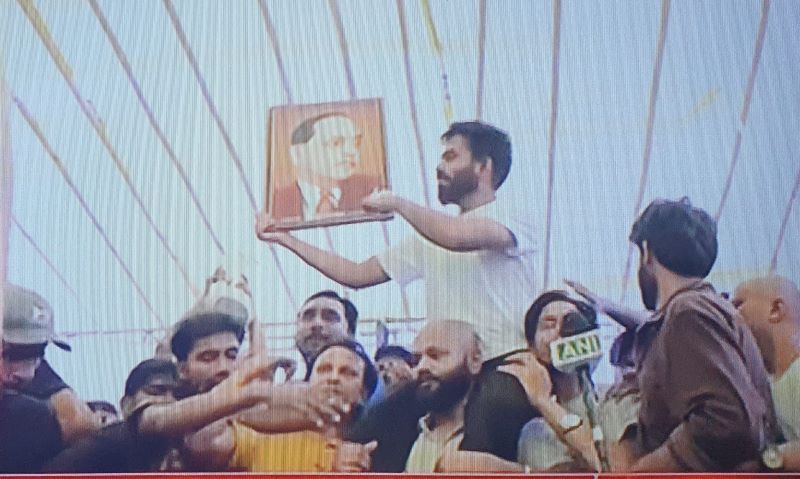
Holding Dr Ambedkar’s photo at both the start of the protests and at the moment of Education Minister Dharmendra Pradhan’s resignation marked a monumental victory for civil resistance. It signified that a movement led by Abhijit Dipke, a Dalit youth, grounded in Ambedkar’s vision, successfully cut across India’s deep political, religious, and economic divides. The image of Ambedkar served as a unifying banner, rallying citizens nationwide and students globally, ultimately forcing the Indian government to concede to demands for institutional changes to future-proof against exam paper leaks.
But for now, the streets of Delhi belong to the youth. They took a dehumanising slur, built a 26-million-strong digital army, outmanoeuvred the state’s iron fist, and proved that even the most deeply entrenched political powers can be forced to bow to the will of a united generation.