
SAMAJ WEEKLY UK

Bal Ram Sampla
Geopolitics
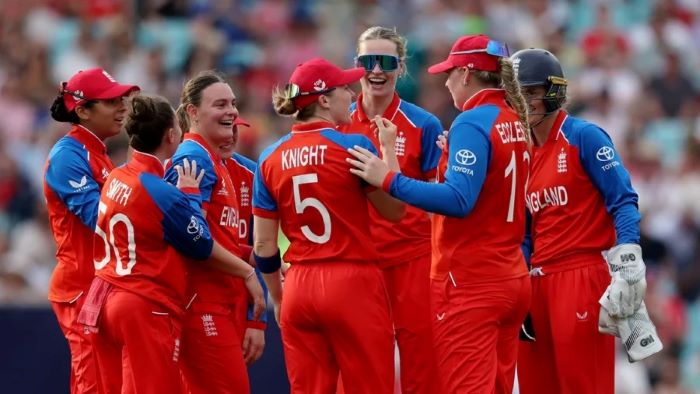
When Australia strolled to a seven-wicket win over England in the Women’s T20 World Cup final at Lord’s on July 5, 2026, the result hardly felt like a contest. Chasing 151, Beth Mooney and Phoebe Litchfield put on 100 runs off just 67 balls, and by the time Ellyse Perry and Ashleigh Gardner finished the job, Australia had cruised home with 17 balls to spare. For a final, the biggest stage in the women’s game, it was a strangely one-sided affair, and the roots of that lopsidedness lie squarely in England’s batting approach.
A total that never asked the right questions
England posted 150/4 from their 20 overs, built around captain Nat Sciver-Brunt’s unbeaten 58 off 53 balls. On paper, an anchor knock from the captain in a final looks like exactly what a team needs. In practice, a strike rate of roughly 109 from the one recognized batter who lasted the distance is simply too slow against a batting line-up as dangerous as Australia’s, one stacked with Mooney, Litchfield, Perry, and Gardner, all in career-best form throughout the tournament.
The tragedy of England’s innings is not that Sciver-Brunt failed — she was, statistically, the one player who held the innings together , but that her caution was never balanced by urgency elsewhere. Freya Kemp’s contribution lifted England to a “respectable” score, but respectable was never going to be enough. Set against a team capable of chasing 171 in a group match just days earlier (their record run chase against India), 150 was a target Australia could and did, treat as a formality.
The commitment to accelerate — the “guns blazing” approach needed to arrive by around the 15th over, when boundaries were still gettable and wickets were still in hand. Instead, the aggressive intent came too late to meaningfully lift the total, and by then the match had already tilted toward a total Australia would find comfortable rather than testing.
A pattern, not an isolated failure
England were not alone in this mistake at this World Cup. In the group stage, India’s middle overs against Australia stagnated badly ,Jemimah Rodrigues and Harmanpreet Kaur’s stand crawled to just 134/2 after 18 overs before a frantic final-two-over onslaught (36 runs, three consecutive sixes from Harmanpreet) inflated the total to a more presentable 170. The headline figures — a fifty in 25 balls — flattered an innings that had, for most of its duration, been far too passive. India still lost, comprehensively, to a superior Australian chase.
Conclusion
England’s 150 was not a total built on smart, low-risk cricket; it was a total built on hesitation. A genuine intent to reach 175, initiated with overs still in hand rather than panic in the 19th, might have given England’s bowlers something to defend and forced Australia’s celebrated batting line-up to actually work for their title. Instead, the tournament’s best team was allowed to play within itself, and a final that should have been a showpiece contest turned into a straightforward chase. If there is a lesson from this World Cup, it is that timidity dressed up as “building an innings” is now the costliest strategy in the women’s game.
England 150 -4 20 overs
Australia 153-3 17.1 overs