
SAMAJ WEEKLY
Bal Ram Sampla
Geopolitics

In June 2025, the United Kingdom government made a significant decision to ban Palestine Action, a pro-Palestinian activist group, under anti-terrorism legislation. This marked the first time the UK has used such laws against a domestic pro-Palestinian organization, raising important questions about the balance between national security and the right to protest.
What is Palestine Action?
Palestine Action is a direct action group that emerged to protest what they view as UK complicit in Israel’s military operations. The organization focuses on targeting arms manufacturer that supplies weapons to Israel. Unlike traditional protest groups that organize regular demonstrations, Palestine Action specializes in direct action tactics, including occupying facilities and disrupting operations at weapons manufacturing sites.
The group centers on taking “direct action against Israeli weapons factories in Britain, in solidarity with the Palestinian people.” Their previous activities have included spray-painting facilities, occupying buildings, and disrupting operations at arms manufacturers’ sites across the UK.
Funding Questions
Questions about Palestine Action’s funding sources have become a significant concern for the government. The group appeared to rely primarily on donations from supporters and crowdfunding platforms for their activities and legal expenses. However, investigations by the Home Office have raised concerns about potential foreign funding links, particularly suspected connections to Iran. These investigations into Palestine Action’s donations reflect worries about whether the group may have received support from foreign governments or organizations hostile to UK interests.
The lack of transparency around the group’s funding sources has made it difficult to determine exactly who sponsored their activities. Unlike larger established organizations, Palestine Action did not publish detailed financial reports or donor lists, operating instead through grassroots donations and online fundraising campaigns.
The Incident That Led to the Ban
The government’s decision to ban Palestine Action came after a significant escalation in the group’s tactics. On Friday, June 21, 2025, activists broke into a Royal Air Force base in central England, where they damaged two military aircraft used for refueling and transportation. The activists sprayed red paint over the planes, marking a dramatic shift from their previous focus on civilian arms manufacturers to direct interference with military assets.
This security breach at an RAF base represented a clear escalation that prompted immediate government action. The incident raised serious concerns about base security and demonstrated that the group’s activities had moved beyond targeting private companies to directly interfering with military operations.
The Government’s Response
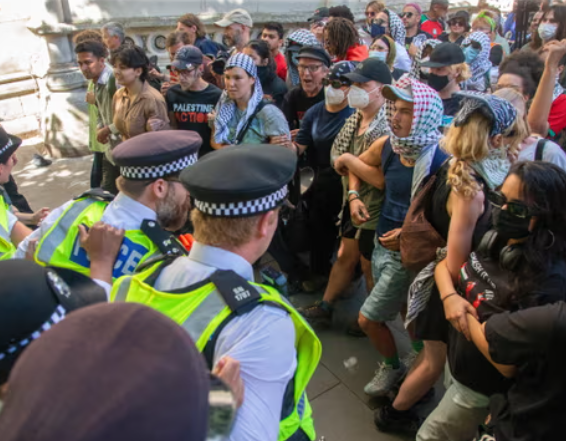
On Monday, June 23, 2025, Home Secretary Yvette Cooper announced that Palestine Action would be proscribed under terrorism legislation. This makes it a criminal offense to belong to or support the group, with penalties of up to 14 years in prison. The decision represents a swift government response, occurring just days after the RAF base incident.
Legal Challenge and Final Implementation
Palestine Action attempted to challenge the ban through the courts. On Friday, July 4, 2025, the group’s co-founder Huda Ammori made an urgent bid to the High Court to temporarily block the government’s ban. However, the High Court refused to pause the ban. In a last-minute effort, lawyers for the group took the case to the Court of Appeal later that evening, arguing that the ban would have a “chilling effect” on free speech.
The Court of Appeal rejected the appeal at just after 21:30 on Friday evening, meaning the proscription came into force at midnight on Saturday, July 5, 2025. This legal defeat marked the final step in Palestine Action’s transformation from a protest group to a banned terrorist organization under UK law.
Controversy and Criticism
The ban has generated little controversy. Civil liberties organizations, including ARTICLE 19, have strongly condemned the decision, arguing that it threatens the fundamental right to protest and dissent.
There have also been concerns raised within the Labour Party itself, with some suggesting that banning Palestine Action may represent an “escalation too far” in response to the group’s activities.
Conclusion
The UK government’s decision to ban Palestine Action, which came into effect on July 5, 2025, after the group’s legal appeals were rejected, reflects the challenge of balancing national security concerns with protecting democratic rights to protest. The failed legal challenge demonstrates that the courts upheld the government’s authority to use anti-terrorism laws against direct action groups, setting a precedent that will likely influence how future governments handle similar situations involving protest organizations and national security concerns.
References
1.https://www.reuters.com/business/aerospace-defense/uk-police-ban-palestine-action-protest-outside-parliament-2025-06-23/
2. https://www.timesofisrael.com/uk-set-to-ban-palestine-action-after-break-in-vandalism-at-british-air-base-reports/
3. https://www.euronews.com/2025/06/23/uk-to-ban-activist-group-palestine-action-after-sabotage-of-military-planes
4.https://www.democracynow.org/2025/6/24/headlines/uk_government_uses_anti_terrorism_law_to_ban_the_protest_group_palestine_action
5. https://www.article19.org/resources/uk-banning-palestine-action-threatens-right-to-protest/
6. https://questions-statements.parliament.uk/written-statements/detail/2025-06-23/hcws729