SAMAJ WEEKLY UK
Vidya Bhushan Rawat
 It was lunch time and participants had gathered outside the National University Hall, to collect their food during the Colombia Day celebration at #Bogota. The volunteers wanted people to be in two separate rows so that they could give it comfortably. Are you ‘regular’ or Vegetarian ? For a moment, I was a bit shocked but then realised that regular was meant for meat eating people and vegetarians were being called separately. I realised how culture changes. In India, we use the term ‘non-vegetarian’ for meat eating people which is not really correct and for many it is made to look like a criminal offence.
 Anyway, when you travel outside the country, you will see how culture changes at every corner and how a thing considered unholier here might not be the same elsewhere. It is therefore important for us to respect the food and cultural diversity. Those who can’t honour such remain confined to their ghettos and enjoy their ignorance and arrogance’ but they remain unfit to even travel. If you are still looking for your home food even after travelling to such a far away place then you really are not enjoying the cultural diversity of the world mostly emerging from the diverse food habits on the planet.
A few years back, when I went to participate in a conference organised by #AsiaLandForum in Kyrgyzstan, we had a nice Vodka party during lunch. It was a tour to a nomadic community in the forest area. We had fish and other things along with several shots of Vodka. After some time, a friend came to me saying that some villagers wanted to celebrate with me. I went towards the other side where a couple of them were just sitting. Vidya, we are happy, you are here. Now, let us celebrate. I said, friend, I have already celebrated and cant go beyond what I have already done. No, we are not offering you any more Vodka ? I told them that, I dont have space for any other thing now and was really feeling sleepy that time during bright sun yet chilled weather. No, you must taste this, he said. I said, what is this ? Oh, this is our favourite product. It is milk of a mere ( she horse). I was shocked beyond anything. I can’t take it, I said. Not that it was horse milk because I don’t have an issue as long as things are taken by human being. My issue was the age old belief that you should not take any form of milky product after eating the fish. I told them, in India, we can never take any milky thing after eating fish. They laughed at me and told me that this is not a new thing for them and is part of their food habit.
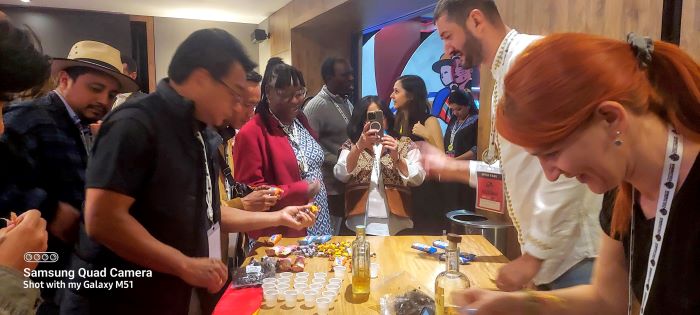
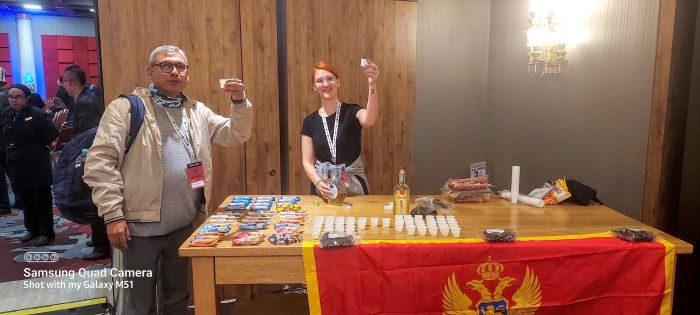
On the last day of #globallandforum #Bogota in #Colombia, our friend from Montenegro, who is campaigning to protect and save the beautiful Sinjajevina forests , activist, journalist Milan Sekulović, offered a unique party to celebrate our togetherness. The programme was to start around 9 am in the morning and Milan and his friend organised a table at the entrance of the auditorium with lots of chocolates and toffees and two bottles of wine. We were not aware of what he was doing. Then he started pouring the wine in different ‘shots’. I saw and was shockingly surprised as to why this is being done so early in the morning. Then, I realised that it is taken in the form of shots, very much like Tequila.
 Anyway, I do not hesitate in testing new things and hence took the initiative. It was absolutely thrilling to take a few of these shots. We Pahadis can take as much and it does not matter whether it is hard or soft. Anyway, Milan said that this is the tradition in Montenegro and other Balakan countries to take this during celebration of an event and here he wanted to celebrate our Assembly of Members at the #globallandforum. We learn a lot from such cultural exchanges.
Takovo Šljivovica is a Serbian Plum brandy and taken along with nuts or chocolates during social gatherings and celebrations. It does not matter whether it is in the morning or evening. You don’t mix it with ‘water’ or ‘soda’ or any other product. It is taken like Tequila shots. It is also taken in the morning as a medicinal thing to warm up the body. Actually, alcohol as a medicinal was part of hill culture. The other product displayed by Milan was Meduška, a honey brandy from Montenegro.
I loved this surprising initiative by my dear friend Milan. Despite travelling to so many countries during the past thirty five years, I still feel the urge to learn and taste different foods and wines world over. I may not know the name but I love being with native and indigenous people and celebrating with them.
 At the #amazonian #territory village of Aqua Bonita, I loved the way the #indigenouspeople carried out the programme. Elderly people have special respect and all the events and ceremonies are actually inaugurated by the elders of the community. They bless you and pray for your well being. Water and fire play an important role in the lives of Indigenous people. And it is very much like our own where our ancestors prayed for the well being of others in perfect harmony of nature. Elderly people were sprinkling water over everyone with the native plants. Often, we, the urban ‘educated elite’ term these as irrational and superstitious. I have been a humanist and often saw people mocking them which is unfair. Indigenous communities’ relationship with nature need to be understood. Their relation with their families and elders are also extremely important. While we enjoy the ‘individualism’ they love their community life. We need to stop the mindless destruction of our heritage in the name of development. I have stopped treating our mountains and rivers as ‘resources’ as for me they are my identity and cultural heritage. As long as we treat them as ‘resources’ they are bound to be exploited by the greedy classes. And for that to happen, we need to learn from the lives of indigenous people. They provide us hope for the future. They are dependent on nature yet protect it too.
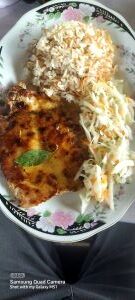
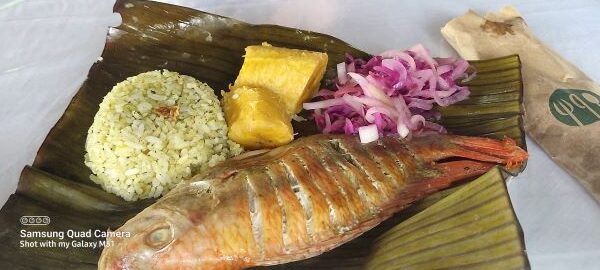
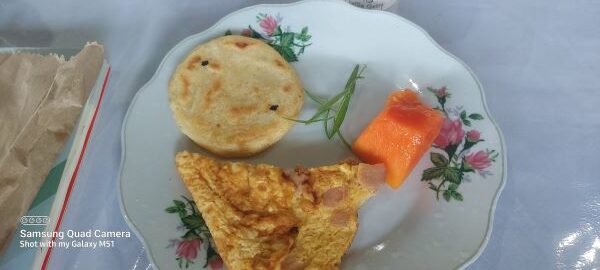
The best food I ate at Agua Bonita village was grilled fish added with local products like rice and lemon onion. It is called ‘Plato Mojarra Roja Pescado de Lago, platano , arroz y ensalada roja’ : Mojarra is a red fish found in abundance in the Amazonian lakes, rivers and riverines and most likely from Orteguaza or San Pedro Rivers, known for its firm, flavourful flesh which is a staple in Caquetá’s Amazonian diet. It was simply delicious. Interestingly, none of the cooked food that we had with indigenous people had oil and they were simply outstanding. Also interesting was that each day, we had a different dish. No dish was repeated in the evening. It was simply outstanding and made me remember the Tandoori Queen fish, I ate at Kumarakom, Kerala. There is no doubt that Kerala remains supreme in many thing including ‘regular’ recipes. There were other recipes too in the Amazon region including those made of local maze, corn, Banana, cucumber etc. Pork, beef, fish and chicken too is part of the local traditions. Coffee is the most famous product apart from other items like honey etc. Carne a la Plancha con Arroz Mixto y Ensalada Blanca which was grilled pork with cabbage-onion mixed salad, Omelet con Huevo y Salchicha, Arepa y Papaya which was an omelet grilled with Papaya. I enjoyed each dish as everything was just new for me and the best part is I love tasting new things. We can understand the culture of others if we suffer from food prejudices.
It was interesting to hear an elder of the community when speaking asking us to chew something like tobacco and drink alcohol as nature would be happy.
 Agua Bonita is a small village yet it has a bar, a football ground. It was amazing to see girls playing football. I am saying it amazing not because of anything but in such a remote area of the country where reaching itself is a big challenge. People watch football matches. Adjacent to it is a bar which is like a normal restaurant where men and women come, drink together and dance. I saw elders sitting in the bar and community young women taking care of them, giving them company. Unlike our part of the world, where such places are typical ‘male chauvinist clubs’, in Latin America, this is purely an evening where people want to enjoy with their near dear ones. It was amazing though people like us feel awkward many times that we can’t dance. The Colombians really dance so well.
That is why, I say, life is different and diverse. Please don’t look down upon people who do not ‘fix up’ in your compartment. The world is beautiful because it has diversity. Nobody should force his thought and cultural beliefs on others. The best cultural belief would be to embrace all the cultures and appreciate them even if you don’t need to eat or drink everything that is being offered. We do have our issues cant change but what is possible is that don’t feel offended by people enjoying their lives and enjoying a drink or a food at some place. If we want to take our home everywhere we visit then we don’t need to step out. There is no meaning to travel if we can’t enjoy the food culture of the countries we travel to. Travel does not mean having a selfie and posting it on your Instagram or other social media. Travel provides you an enormous understanding of communities and societies. Nothing is more important than that feeling of understanding others without making comments about the food habits which we might not feel comfortable with.
One more important learning is that many times, these field visits and one to one conversations beyond the ‘business hours’ of our conferences, bear greater results and unity than anything else particularly, it provides us so many insights about a community that a normal seminar or conference can not do that.
So thank you #internationallandcoalition and the local organisers in #colombia for enabling us to visit the beautiful place and enriching our experience and understanding.