SAMAJ WEEKLY UK
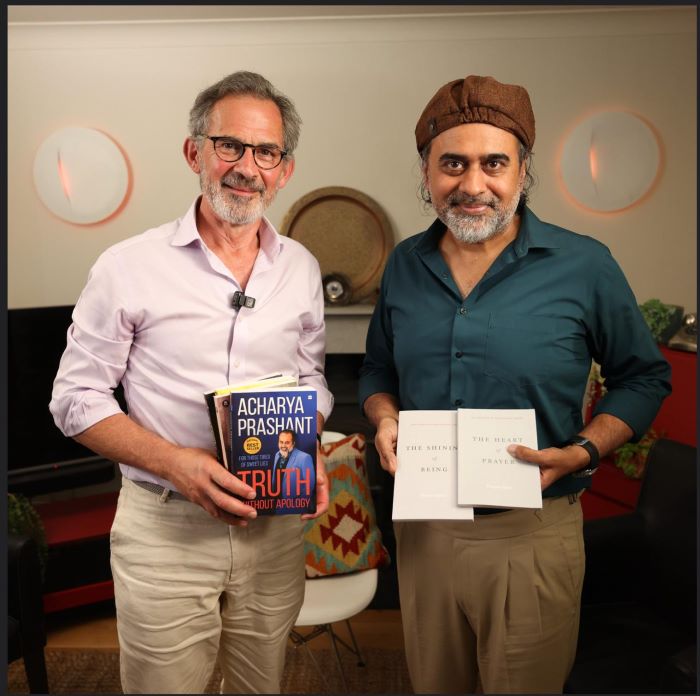
London, July 7: Philosopher and author Acharya Prashant and Rupert Spira, a popular teacher of non-duality in the West, held a public dialogue in London on Tuesday on suffering, the self, and the meaning of non-duality. The moderated conversation brought together two speakers who have approached the same question from opposite ends: what a person actually is beneath the story they have been told about themselves.
Spira, who has held retreats across the United Kingdom, Europe and the United States, opened by locating the human problem in suffering on the inside and conflict on the outside. Both, he said, follow from what he called the paradigm of separation, the assumption that we are separate from one another, from animals, from the Earth and from the ultimate reality. Any solution built on that same assumption, he argued, will eventually reproduce it, which is why the world sees only temporary ceasefires and temporary relief. He offered the non-dual understanding as an alternative, summarising it in a single line: “peace and happiness are the nature of our being, and we share our being with everyone and everything.”
Acharya Prashant agreed with the diagnosis but shifted its centre. The problem, he said, is not suffering but the sufferer. “The sufferer is the problem,” he said. “The sufferer is the ego.” He described the ego as an entity with two universes to hide in, the external world of objects and the internal world of spiritual concepts, and cautioned that lofty words such as truth, liberation and enlightenment can become fresh places for the sufferer to conceal itself. “Truth is food to the ego,” he said, adding, in a line he attributed to Lao Tzu, that truth becomes a casualty the moment the word is uttered.
The two diverged most clearly on the nature of awareness. Spira described awareness as unconditioned, ever present and changeless, the one self that all beings share, likening it to the single space that appears divided by the walls of separate rooms.
Acharya Prashant declined to grant awareness that standing without inquiry. He said the only entity that ever declares “I am” is the ego, and that awareness in daily experience always carries an object and a subject who is the one that suffers. He refused, he said, to let that subject hide behind the concept of awareness. His preferred method was self-knowledge, what the Indian tradition calls adhyatma, the honest observation of the ego by itself. “The seer does not survive the seeing,” he said.
On the figure of the witness, invoked often in non-dual circles, Acharya Prashant argued that it has been tragically misread as an entity rather than an attitude. Only the ego can observe itself, he said, because the ego is available to no other observer; witnessing, in his account, is simply honesty in self-observation, undertaken without concern for its consequences. Spira described recognising oneself as the witness as a genuine but partial step, a move back from the body and mind that must then be followed by an inquiry into the nature of the witness itself.
The conversation turned more personal after both speakers gently invited the moderator to set aside his prepared questions and ask something he actually wanted to know.
What followed was an exchange on why philosophical seeking so often fails to end. Acharya Prashant drew a distinction he returned to repeatedly, between immersion and intoxication. “Immersion is a thinning down of the self,” he said, describing intoxication, by contrast, as the self growing heavier. Entertainment, money, power, travel and endless shopping, he said, are intoxicants that briefly relieve the seeker without touching the source of the seeking, and he linked this pattern directly to the environmental crisis: “this cult of happiness is what is destroying the planet.”
Both speakers cautioned against a familiar misuse of their own vocabulary. They agreed that the ego is capable of appropriating even the highest understanding, using ideas such as staying as the witness to excuse passivity and to avoid moral responsibility in the world. Acharya Prashant argued that genuine responsibility is not a code of conduct to be performed but something that arises naturally once the ego thins, offering as illustration his view that “true love fulfils promises that were never even made.” Spira, drawing on the same concern, noted that history is full of people using the language of wisdom for egoic ends, which is part of why the field itself is often discredited.
Asked how a seeker should decide which teacher or text to trust, both men returned the question to the individual. Spira advised trusting nothing but one’s own deepest experience, and only those that encourage the same self-reliance. Acharya Prashant described the role of a genuine teacher as holding up a mirror rather than handing over conclusions, questioning what the student already takes to be true rather than supplying a final truth that cannot, in his view, be delivered to anyone.
The dialogue closed on a note of agreement. Spira invoked T.S. Eliot’s Four Quartets, evoking the idea that all our exploring finally returns us to where we began, so that we come to know the place for the first time. He offered a summary line that both speakers repeated back to each other: “No questioner, no teaching.” Acharya Prashant answered it with a phrase from the Zen tradition: “No moon, no lake.”
The Spira dialogue forms part of Acharya Prashant’s ongoing engagements across the United Kingdom. He has addressed audiences at Cambridge, Oxford and the House of Lords, discussed animal consciousness and the environment with Professor Jonathan Birch at the London School of Economics, taken part in a fireside conversation at PETA’s London office, was invited for a documentary and podcast conversation with the psychologist Dr Melanie Joy, and held a separate dialogue with the Cambridge-trained
biologist Rupert Sheldrake. His engagements also include a conversation with Professor Lars Chittka of Queen Mary University of London, on questions of consciousness, freedom, non-violence and the climate crisis.
Acharya Prashant is an alumnus of IIT Delhi and IIM Ahmedabad and the founder of the PrashantAdvait Foundation. His work, rooted in Indian and global philosophy, reaches more than 100 million subscribers across social media. He was recently featured the Watkins 2026 list of the world’s most influential living thinkers.