
SAMAJ WEEKLY UK
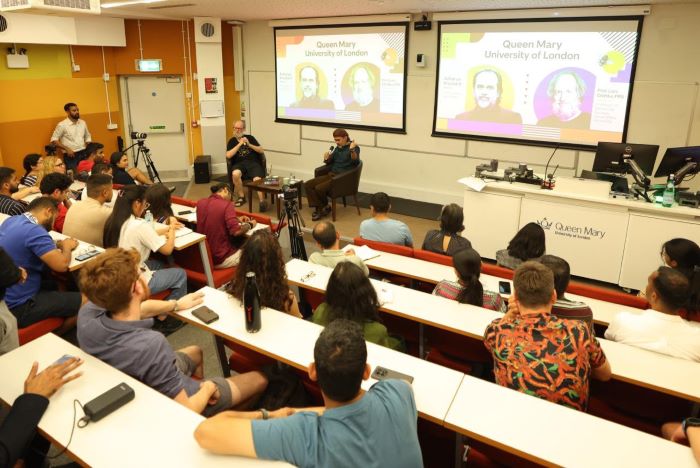
London, July 7: The Queen Mary University of London hosted a dialogue between philosopher and author Acharya Prashant and Professor Lars Chittka FRS, on Monday, in a wide-ranging conversation that moved from the inner life of bees to the human ego and the origins of the climate crisis. The exchange drew students, researchers and members of the public, who applauded repeatedly as the two speakers built on, and at times gently questioned, each other’s positions.
Professor Chittka is Professor of Sensory and Behavioural Ecology at Queen Mary University of London and founder of its Research Centre for Psychology. His book ‘The Mind of a Bee’ argues that bees are capable of learning, counting, tool use, basic emotion and possibly a form of consciousness. He was elected a Fellow of the Royal Society in 2026. Acharya Prashant, whose work centres on the self and the human ego, is ranked among the top twenty of the Watkins 2026 list of the world’s most influential living thinkers.
Opening the conversation, Professor Chittka said he had studied Acharya Prashant’s work and asked what he had found compelling in the research on bees. Acharya Prashant replied that curiosity about other species is common, but selfless curiosity is rare. “Curiosity in the other is not so rare,” he said. “What is rare is selfless curiosity in the other.” He argued that most discovery is eventually appropriated by the ego, which he described as “the master exploiter,” and put to the service of self-preservation, so that even research into decoding animal communication risks being turned into a more efficient means of exploiting animals.
Professor Chittka offered what he called a more hopeful reading. He recounted how his laboratory had once, half in jest, trained bees to recognise human faces, and how the study drew the interest of the US military in the years after 2001, but he declined to assist. He also described how whale song was first recorded by the US Navy during Cold War submarine surveillance, then passed to a biologist and released as a record album, helping to galvanise the global campaign against whaling. Science and even the military, he suggested, can end in the protection of nature rather than its exploitation.
Acharya Prashant contended that the whales had needed saving only because human beings had hunted them, and that congratulating the species on rescuing one animal from a danger it had itself created was not grounds for optimism. He argued that no other species pollutes, litters, or drives itself towards extinction, and that the planet has always been well without human intervention. “Give me one problem on the planet that is not man-made,” he said. He located the difference not in human biology, which he said is almost entirely shared with animals, but in what he called the psychological self, or ego, an error unique to the species.
Much of the dialogue turned on the nature of violence. Acharya Prashant maintained that animals are not violent, because violence requires a psychological choice that a predator acting on physical need does not possess. “Violence exists only when there is a psychological choice available,” he said, drawing a distinction between a lion that hunts to eat and a human being who kills for a trophy. When Professor Chittka countered with examples of apparent cruelty in the animal world, from infanticide among lions to warfare among chimpanzees, and suggested that cats and wolves appear to kill for the thrill of it, Acharya Prashant cautioned against anthropomorphising, arguing that the human problem is not killing itself but a psychological emptiness that no amount of killing or accumulation can fill.
That emptiness, he said, is what drives a person to pursue a fortune long past any physical need, and what he described as the 3 AM loneliness felt even by those who appear to have everything. He linked it to rising rates of obesity and lifestyle disease, contrasting the human being who eats for the mind with the lion that eats only for the body.
Asked how his message differed from the charity and modesty taught by the world’s religions, Acharya Prashant said all religion is addressed to the human being alone, because only the human being carries the suffering ego, and that the true purpose of every religion is the dissolution of that self rather than a set of rituals and commandments. “Kindness is natural,” he said, adding that no small child is eager to kill a lamb or a rabbit, and that the real question is how the ego is taught violence in the first place. He noted that he had made the same point in recent conversations with senior figures at PETA and with the psychologist Dr Melanie Joy.
During the audience discussion, questioners pressed him on the relationship between ego, consciousness, self-awareness and intelligence, on whether behaviour might be explained by the drive to pass on one’s genes, on how to respond to abuse, and on why more scientists now treat consciousness as inseparable from the observer. Acharya Prashant described the ego not as the doer but as “the distorter,” a claimant that steals credit for actions it did not perform. On consumer choice, he suggested that a shopper often buys not an object but a story, “because the ego is the first story, the fundamental superstition.”
Responding to a call for cooperation among like-minded people, Acharya Prashant said cooperation is natural and is blocked only by the psychological self, and cautioned against reform that does not begin with self-understanding. “Cooperate without asking who the cooperator is,” he said. “Change without understanding what’s broken.” Asked whether the world might benefit from more figures like him, he said the aim was not emulation but subtraction. “You un-become who you are,” he told the questioner, describing the entire process as one of demolition rather than acquisition.
Professor Chittka, for his part, said that the moment one recognises something needs fixing, one begins with oneself, whether by changing one’s diet or giving up a car, and that reversing the ecological crisis would require many people working together, each contributing a small part. He described his own shift away from childhood fishing and towards a plant-based diet as evidence-based, shaped by what research had revealed about the inner lives of insects.
Recalling an earlier conversation in which Professor Jonathan Birch had asked him for hard data on the impact of his work, Acharya Prashant said good outcomes follow on their own once the inner source of harm is addressed. “Good things happen on their own when the source of evil is challenged,” he said, “and that resides within each one of us.”
The Queen Mary dialogue forms part of Acharya Prashant’s ongoing engagements across the United Kingdom, where he has addressed audiences at Cambridge, Oxford, the House of Lords, the London School of Economics and PETA’s London office on questions of clarity, freedom and the ecological crisis. Acharya Prashant is an alumnus of IIT Delhi and IIM Ahmedabad and the founder of the PrashantAdvait Foundation. He was recently featured in the Watkins Magazine’s list of most influential global thinkers thinkers.