By: Surjit Singh Flora

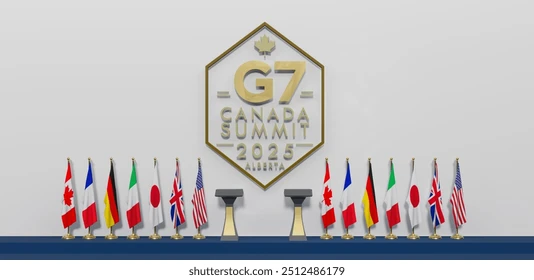
(Samajweekly) The leaders of the G7, comprising the world’s wealthiest democracies, convened in Kananaskis, Alberta, Canada, from June 15 to 17. The meeting served as a significant demonstration of the G7’s resolve to maintain unity during challenging circumstances.
The most recent G7 meeting took place in Canada in 2018, during which President Donald Trump, in the early stages of his presidency, departed from the summit in a state of anger.
He declined to endorse the concluding joint statement, issued threats regarding tariffs against his fellow leaders, and characterised the Prime Minister of Canada, Justin Trudeau, as “very dishonest and weak.”
However, on this occasion, Trump departs from the G7 summit prematurely to address the
Israel-Iran conflict. It is now widely recognised that Trump’s second presidency is significantly more controversial than the first. The fractures within what can scarcely be referred to as the “Western family” have now been thoroughly exposed. In the interim, European initiatives have predominantly concentrated on preventing a severe rupture with the United States rather than attempting to mask the unease stemming from division. Given this new reality, a successful summit is characterised by the absence of melodrama or significant confrontation. Mitigating the damage has emerged as a goal in its own right.
While Mark Carney has found himself in the unusual position of hosting a US president who has repeatedly claimed that his country, Canada, should be the 51st US state, he has had to explain to him that his country is not for sale. For this year’s summit amid a perilous escalation in the Middle East and Mr. Trump’s reshaping of global alliances.
Also, as soon as Indian PM Narinder Modi lands at Calgary airport, some Sikhs and MPs oppose his G7 attendance, citing India’s human rights record. Despite this, the new information-sharing pact is a major step toward normalising relations and addressing internal security challenges in both nations.
While the advocacy group Sikhs for Justice held a day of protests Monday, Modi landed at the Calgary airport in the evening and then made his way to the summit in the nearby wilderness retreat of Kananaskis. Then on Tuesday, condemning Indian Prime Minister Narendra Modi as he visits the G7 leaders’ summit.
The protest in downtown Calgary included posters of the leader handcuffed in a prison jumpsuit and another depicting him behind bars. The relationship between the two nations has worsened since Canada accused Indian Government agents of assassinating Hardeep Singh Nijjar, a 45-year-old naturalised Canadian citizen and prominent advocate for a separate Sikh homeland in India. New Delhi calls the claims “absurd” and “preposterous.” Punjab is uneasy about India-Canada tensions over the Sikh slaughter. The controversy damaged India-Canada ties, prompting diplomatic expulsions in 2023 and 2024.
Canadian Prime Minister Mark Carney is open-minded and forward-thinking. He warmly invited Modi to attend the summit, despite India’s economic, commercial, market, and strategic importance. In this digital technology era, the G7+5, an informal alliance of major developing economies, has invited India, Mexico, Brazil, and South Africa as guests in previous years. India, Brazil, South Africa, Russia, and China founded the BRICS alliance of developing countries, which some see as a mirror of the G7’s geopolitical and economic competition.
The G7 and invited parties reached a wide consensus on these invitations. The data shows India’s 50-year exit from the G7, while the invitations emphasise the guests’ economic might outside. With less than 1 per cent of the world’s GDP, Russia first visited the G7 in 1992. Meanwhile, the five original BRICS nations had less than 9 per cent of world GDP. The G7 accounted for 63 per cent of global GDP. The G7 currently accounts for 44 per cent of global GDP, whereas the original BRICS have quadrupled to 25 per cent. Since becoming the 47th President of the United States for the second time on January 21, 2025, Trump’s aggressive, capitalist, and expansionist policies have caused turmoil in the US and across the globe. Trump’s terror tariffs and immigration crackdowns have sparked violent demonstrations in several US states for the second time. On April 5, 2025, 1400 sites in 50 US states conducted the first anti-regime protests.
Now violent demonstrations against immigration deportation continue. Canada joined in 1976.
The G-8 group included Russia, but it ejected it in 2014 for annexing Crimea. These gatherings often include other major nations. France hosted this organisation’s 2019 conference and welcomed India for the first time. Invitations have continued since.
The world’s fourth biggest economy is India. India has a greater economy than France, Italy, Canada, and Japan. Canada needs new trustworthy partners to address global peace, law, and order issues. After Justin Trudeau’s Liberal Party beat Stephen Harper’s Conservatives in 2015, Canada was in high demand worldwide. Now things have changed. At the summit today (Tuesday), Prime Minister Modi will address energy security, technology, and innovation, particularly the AI-Energy Alliance and quantum challenges, with G7 leaders, invited outreach nations, and international organisation leaders.
Canada spent $300 million and $600 million hosting the G-7 meetings in Huntsville, Ontario, in 2010 and Charlevoix, Quebec, in 2018. This meeting should deliver important outcomes.
The Indian Prime Minister may have a chance to address national interests, diplomatic, trade, economic, and military problems with G-7 and other leaders, as well as Pakistan’s role in worldwide terrorism.
While Indian political observers say Modi’s visit may allow Canada and India to rebalance ties. As Canada’s prime minister since March, Carney has raised hopes of a thaw. According to former Indian envoy to the US Meera Shankar, Modi’s trip will “hopefully mark the beginning of a reset in India’s relations with Canada, which have plummeted over the Canadian allegations regarding the Nijjar case and India’s belief that Canada indulges Sikh extremism directed against India.”
She said both sides gain “if the relationship is stabilised, particularly in a volatile world. With bilateral trade hitting $9 billion in 2023 and Canadian pension funds investing $55 billion in India, India and Canada have strong commercial and interpersonal ties. About 5 per cent of Canada’s population is Indian, with roughly 2 million living there. The US and North America are the top choices for Indian students pursuing higher education.
Outstanding issues and relationship implications
New Delhi and Ottawa are trying to repair their ties, but Nijjar’s murder remains unsolved. The group supports “Khalistan,” a fringe separatist movement seeking an independent Sikh state from India. New Delhi wants stricter steps against India’s banned Khalistan movement.
On the other hand, Senator Baltej Singh Dhillon, a former member of the Mounted Police, wrote in a public essay on Sunday that “inviting Prime Minister Modi currently represents a troubling departure from our principles.” He also stated that “prioritising short-term strategic calculations over long-term democratic values” “sends the message that trade, and geopolitical interests matter more than sovereignty, justice, and public trust” and that “there are no real consequences for foreign interference in our democracy.” In the end, the meeting will test Canada’s global leadership and Carney’s diplomacy. Canada has a unique opportunity to establish a host. If this summit goes well, Canada might become a more vital Western partner amid high tensions and risks. Canada may lose credibility for years if it doesn’t.