By: Surjit Singh Flora

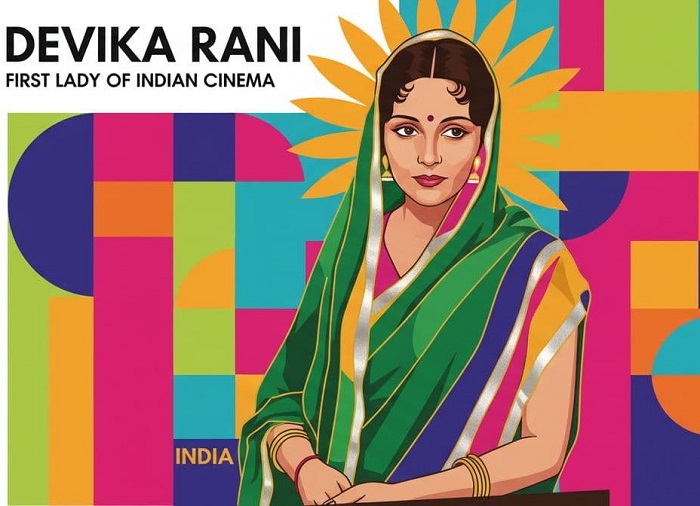
(Samajweekly) Long before Bollywood became a global brand, Devika Rani helped give Indian cinema its early shape. She was a major star, but fame alone doesn’t explain her place in film history.
The title “First Lady of Indian Cinema” fits because she did two jobs at once. She drew audiences to the screen, and she helped build the studio culture behind it. When the Government of India named her the first recipient of the Dadasaheb Phalke Award in 1969, it recognized more than a celebrated actress. It honored one of the people who helped create modern Hindi cinema.
Devika Rani was born on March 30, 1908, in Waltair, near present-day Visakhapatnam. She came from a wealthy, educated Bengali family with links to Rabindranath Tagore through her extended family. That background placed her inside a world of literature, art, and public life from childhood.
At nine, her family sent her to boarding school in England. Those years mattered. She grew up with a social ease, fluency, and outward confidence that set her apart in the Indian film world of the 1930s. At a time when cinema still carried social stigma in many elite circles, she entered it without apology.
Her education in England went far beyond schoolroom polish. She studied at the Royal Academy of Dramatic Art and the Royal Academy of Music in London. She also trained in design, including decor, textiles, and set work.
That mix gave her unusual range. Early film studios needed far more than attractive stars. They needed people who understood performance, costume, space, and visual rhythm. Devika Rani arrived with a performer’s discipline and a designer’s eye, and that combination later gave her unusual authority inside the studio system.
Her path into film began in London in 1928, when she met filmmaker Himanshu Rai during work on A Throw of Dice. She contributed to costume design and art direction, and the partnership soon became personal as well as professional. They married in 1929, then trained in Germany at UFA Studios, where they absorbed a more organized model of film production. German studio practice exposed them to strict schedules, separate departments, and technical standards that Indian filmmaking had not yet made routine.
Their collaboration brought Devika Rani to the screen in Karma, an English-language film released in 1933. It drew attention outside India and presented her as a modern, poised actor who could move across cultural settings with ease.
The film became famous for an on-screen kiss with Himanshu Rai, a scene that unsettled many viewers and fascinated others. In early Indian cinema, that kind of image was a risk. Devika Rani took it anyway. Her willingness to test public limits made clear that she wasn’t content with safe roles or timid presentation.
After returning to India in 1934, Devika Rani and Himanshu Rai co-founded Bombay Talkies in Malad, Bombay, with Rajnarayan Dube and other partners. The studio was built on professional lines and is widely described as India’s first fully functional film studio. It brought technical order, disciplined production, and a new sense of scale to Hindi cinema. Its floors, equipment, and work routines gave actors and technicians a stable place to learn.
Devika Rani was central to that enterprise. She acted in major Bombay Talkies films, and she helped shape the tone of the studio’s output. Films such as Jeevan Prabhat, Achhut Kanya, Nirmala, and Durga mixed popular appeal with social themes. Her pairing with Ashok Kumar became one of the best-known screen partnerships of the decade.
Her appeal did not rest on beauty alone, though contemporary audiences often described her as luminous. What set her apart was control. She acted with restraint, spoke with clarity, and carried an air of education that read as modern rather than distant.
That difference mattered in films like Achhut Kanya, where romance met the hard facts of caste. She often played women with inner will, moral weight, or social awareness. Hindi cinema had seen stars before, but Devika Rani helped define a new kind of leading woman, polished, emotionally intelligent, and tied to the larger world outside the frame.
By the time the Government of India gave her the Dadasaheb Phalke Award in 1969, Devika Rani had been away from regular film work for years. Yet the choice was exact. The award is India’s highest honor in cinema, and its first recipient had to be someone whose work altered the industry itself.
She was not an honorary choice made out of sentiment. She was one of the industry’s earliest builders. She was an early star with international reach. She co-founded a major studio and helped popularize films that joined entertainment with social themes. Earlier, she had also received the Padma Shri in 1958. Later, she received the Soviet Land Nehru Award in 1990.
Her film career ended early. After internal disputes at Bombay Talkies and conflict with manager Sashadhar Mukherjee, she withdrew from the industry in 1945. She later married the Russian painter Svetoslav Roerich and lived near Bangalore, far from Bombay’s film circles.
Distance, however, did not reduce her place in cinema history. The studio discipline she helped introduce lasted. So did the image of the educated, self-possessed heroine. When she died on March 9, 1994, her public life had long since narrowed, but the industry she helped shape had only grown.
Devika Rani changed Indian cinema from the inside. She was an actress, a studio co-founder, and a cultural bridge between India and Europe. That mix explains why “First Lady of Indian Cinema” still sounds precise rather than ceremonial.
Her importance was never limited to stardom. It lived in Bombay Talkies, in the roles she chose, and in the national honor she received first. Bollywood’s later confidence rests in part on foundations she helped lay.