SAMAJ WEEKLY UK

Bal Ram Sampla
Geopolitics
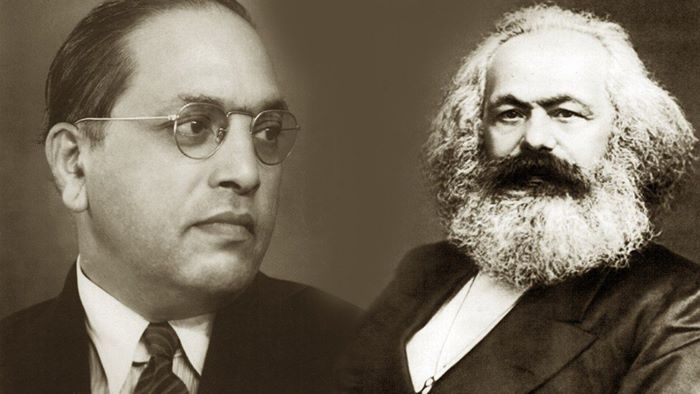
Dr. B.R. Ambedkar was one of India’s greatest thinkers, lawyers, and social reformers. Because he spent his life fighting for the rights of the poorest and most oppressed people in India, he studied Karl Marx’s ideas very carefully. Marx, after all, was the world’s most famous thinker when it came to helping poor workers fight against rich bosses.
Ambedkar respected Marx, but he did not agree with him on everything. To understand Ambedkar’s view, we have to look at what Marx wrote about India in his 1853 article, and how Ambedkar viewed Marxism as a whole.
The Clash Over the 1853 Article: Class vs. Caste
In 1853, Karl Marx wrote that India had “no history at all” and that its villages were completely unchanging. He believed that the only thing that drove human history forward was class struggle, the fight between the rich who own factories or land, and the poor who do the labour. Because Marx thought Indian villages shared everything and didn’t change on their own, he thought India was stuck in the past until the British arrived with railroads and capitalism to shake things up.
Ambedkar looked at Indian villages and saw a completely different reality. Where Marx saw a peaceful, unchanging community, Ambedkar saw a system of deep cruelty. Ambedkar knew that the Indian village was not a place of equal sharing; it was the birthplace of the caste system.
Ambedkar’s biggest critique of Marx’s worldview was that Marx only looked at economics (money and property) and completely missed social status (caste). In India, a person’s life wasn’t just shaped by how much money they had, but by the caste they were born into. Ambedkar famously wrote that the caste system wasn’t just a division of work; it was a “division of laborers.” It split poor workers against each other. An upper-caste worker would still look down on a lower-caste worker. Ambedkar argued that you could not have a successful workers’ revolution in India without destroying the caste system first.
Where Ambedkar Agreed with Marx
Despite this major disagreement, Ambedkar found a lot to admire in Marx’s general writings:
1. Ending Exploitation
Ambedkar completely agreed with Marx that the rich exploiting the poor is the biggest problem in society.
2. State Control
He agreed that the government, not greedy private companies, should control key industries like railroads, insurance, and large agricultural lands so that wealth could be shared more fairly.
Where Ambedkar Chose a Different Path
While they shared the same goal, a fair society where no one is exploited:
Ambedkar strongly disliked the methods proposed by later Marxists.
Marxism often argued that the poor should use violent revolution to overthrow the rich and establish a “dictatorship of the workers.”
Ambedkar was a democrat and a lawyer who drafted the Indian Constitution. He fiercely rejected violence and dictatorship. He believed that if you change a society using force and bloodshed, that society will never be truly free. Real change, he argued, must come through law, voting, and peaceful democracy.
Furthermore, Marx famously called religion “the opium of the people,” believing it just kept poor people asleep and obedient. Ambedkar disagreed. While he hated the inequalities found in Hinduism, he believed human beings naturally need spiritual and moral values to live together peacefully. Without a moral compass, people would forget about “fraternity” (brotherhood and treating others as equals).
Conclusion
In the end, Ambedkar felt that Marx’s ideas were too narrow for India. Marx looked at the world through a European lens, seeing only money and classes. Ambedkar showed that in India, caste was an even bigger wall than class.
To achieve a fair world, Ambedkar ultimately turned away from Marx’s ideas of violent revolution and turned toward the peaceful teachings of the Buddha. He believed that changing people’s hearts and minds through moral teaching was a much stronger and safer way to build an equal society than using force.
References
1.Marx in Ambedkar’s thinking https://www.forwardpress.in/2017/08/marx-in-ambedkars-thoughts/
2.https://www.roundtableindia.co.in/dr-b-r-ambedkar-from-opprobrium-of-the-vedas-to-the-negation-of-karl-marx-and-surrender-to-the-nastika-buddhism/?hl=en
3.https://www.tandfonline.com/doi/full/10.1080/00856401.2015.1049726?hl=en-
4.https://theleaflet.in/reading-ambedkar-in-2026/buddha-or-karl-marx-exploring-an-intriguing-inquiry-by-b-r-ambedkar?hl=en-
5.https://www.marxists.org/archive/ambedkar/index.htm?hl=en-