SAMAJ WEEKLY UK
Today, with a heavy heart, I share the passing of my elder brother, my mentor, and one of the greatest influences in my life, Naresh Banga, who peacefully took his last breath in the early hours on Wednesday 24th June 2026.
“Tumhāre Bhagwān kī marzī hai ke tumheṅ sukh de yā dukh. Hamāre Babasaheb ne to hameṅ sirf sukh kā rāstā dikhāyā aur sirf sukh hī dene kā saṅkalp kiyā.”
— Naresh Banga
That single thought beautifully reflected his lifelong faith in Babasaheb’s mission and the Dhamma.
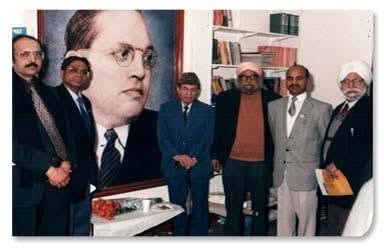 Naresh was an Urdu poet, artist, musician, philosopher, intellectual and a fearless rationalist. His entire life was dedicated to the mission of Babasaheb Dr. B. R. Ambedkar and the spread of the Buddha’s Dhamma. He believed that the greatest tribute one could pay Babasaheb was not merely to admire him, but to continue his work.
He quietly lived what Babasaheb meant by “payback to society.” He donated all of his land and property in India for good causes. He never sought wealth, recognition or fame. His joy came from helping others grow.
Although unknown to many outside close circles, Naresh helped shape the careers of numerous personalities in the music and film industries. He advised producers, directors, actors, poets and singers who later became household names, always choosing to remain in the background.
He served as a consultant on the film Bandit Queen, objecting to the explicit rape scenes while Phoolan Devi was still alive. He also challenged Sir Richard Attenborough, asking why Dr. Babasaheb Ambedkar had been omitted from the film Gandhi.
When Dr. Jabbar Patel was directing the film Dr. Babasaheb Ambedkar, Naresh strongly urged him to include all of Babasaheb’s 22 Vows. Patel explained that, because the film was a Government of India production, there were limitations but Naresh never stopped insisting that Babasaheb’s message should never be diluted.
To me personally, Naresh was far more than a friend or elder brother. He was my greatest mentor, my inspiration, and my guide in both music and social activism. I genuinely believe that without his guidance I may never have entered the world of Ambedkarite activism. Whatever little contribution I have made owes much to his encouragement, knowledge and example.
His knowledge of Buddhism was extraordinary. He had memorised the entire Abhidhamma and could explain the deeper meanings of the Dhammapada with remarkable clarity. Watching groups of monks discussing the Dhamma with him, whether in his home or in viharas, was a common sight. Even learned monks listened carefully when Naresh questioned long-held assumptions, following the fearless spirit of Babasaheb himself.
A lifelong self-learner, he immersed himself in philosophy, Buddhism and Babasaheb’s writings. He taught himself Pali and later Urdu simply because of his love for Urdu poetry. He could recite Diwan-e-Ghalib from memory just as effortlessly as he could discuss the Abhidhamma.
His friendships reflected the respect he earned across many worlds. Gulzar, Ahmad Faraz, Pran, Nusrat Fateh Ali Khan, Ghulam Ali, Salamat Ali Khan and Dilip Kumar, all knew him personally. He and Firdaus Ali wrote the subtitles to Dilip Kumars classic film Mughal-e-Azam. He was also entrusted with handwritten notebooks containing hundreds of tabla compositions by Ustad Allah Rakha himself.
Anyone who entered his home in the UK was immediately greeted by a magnificent floor-to-ceiling painting of the Buddha that Naresh had painted directly onto the wall with his own hands. It silently declared to every visitor, from celebrated musicians to ordinary friends, that before every other identity, he was a Buddhist.
Some of his paintings of the Buddha and Babasaheb, donated by him to Dr Ambedkar Memorial Committee, are displayed at the Buddha Vihara in Wolverhampton.
Naresh could easily have become one of the best-known figures in Ambedkarite and Buddhist circles. Instead, he consciously chose anonymity. He preferred building people rather than building his own reputation. Those of us fortunate enough to know him understand how much the movement has lost.
His body has left us, but his wisdom, compassion, courage and uncompromising commitment to truth will continue to guide generations of Ambedkarites and Buddhists.
Farewell, my dear brother.
You will be deeply missed and never forgotten.
Namo Buddhaya. Jai Bhim.