
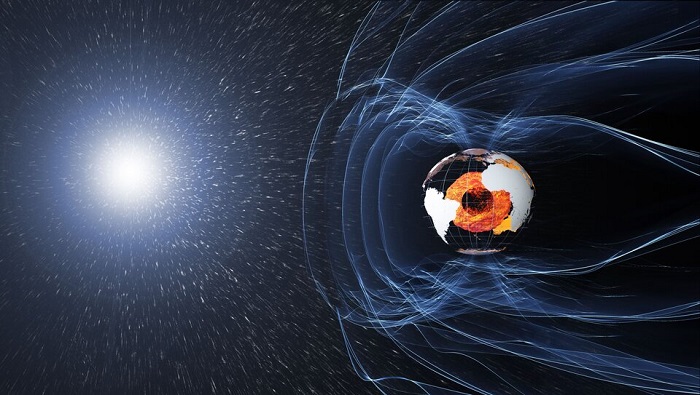

(Samajweekly) The Earth is the third planet of the solar system and it is not a silent planet.Scientifically we can say that it has its own unique electromagnetic “heartbeat” known as the Schumann Resonance. This heartbeat was discovered in the 20th century, this natural phenomenon represents global electromagnetic resonances generated and sustained by lightning discharges in the Earth’s atmosphere. Though it occurs at extremely low frequencies (ELF), its influence stretches across physics, atmospheric science, biology and even human health studies. This essay explores the origin, characteristics, measurement, and scientific significance of the Schumann Resonance.
What is the Schumann Resonance?
The Schumann Resonance refers to a set of extremely low frequency (ELF) electromagnetic waves that exist in the cavity between the Earth’s surface and the ionosphere. These resonances are excited primarily by lightning activity. The basic or fundamental frequency of the Schumann Resonance is approximately 7.83 Hz, with additional harmonics typically observed around 14.1 Hz, 20.3 Hz, 26.4 Hz, and so on.
Historical Background
The idea of electromagnetic standing waves surrounding the Earth was first proposed by Nikola Tesla in the early 20th century. However, it was German physicist Winfried Otto Schumann who mathematically predicted their existence in 1952. Schumann and his colleague Herbert König later confirmed the presence of this global resonance, which was named in Schumann’s honor.
Formation Mechanism
The Schumann Resonance arises from the interaction between:
The Earth’s surface (a good conductor)
The lower ionosphere (a partially conductive layer about 60–100 km above the surface)
This creates a spherical waveguide. When lightning strikes, the energy from these discharges excites the waveguide, generating ELF waves that bounce around the Earth. These waves interfere constructively at specific frequencies, forming standing waves—resonances.
Measurement Techniques
Detection of Schumann Resonances is done with ELF sensors which are specialized instruments capable of capturing electromagnetic signals in the 3–60 Hz range. These measurements require extremely sensitive equipment due to the low energy of the signals and are often conducted in electromagnetically quiet zones.
Major observatories that monitor Schumann Resonances include:
Applications and Significance
a. Global Lightning Monitoring
The intensity and frequency of the Schumann Resonance are closely tied to global lightning activity, which is itself a proxy for global convection and climate conditions.
b. Climate Change Indicators
Shifts in resonance frequencies or amplitudes may indicate changes in global temperature, ionospheric conditions or climate variability, making them useful for atmospheric monitoring.
c. Human Health and Circadian Rhythms
Some researchers suggest that Schumann Resonances, especially the 7.83 Hz frequency, are in tune with the human brain’s alpha wave frequency range (8–13 Hz), which is associated with calm, meditative states. Though speculative, this has led to studies exploring the resonance’s potential influence on biological rhythms.
d. Earthquake and Geophysical Prediction
There is ongoing research to investigate whether disturbances in Schumann Resonances could be precursors to seismic or volcanic activity, though conclusive evidence is still lacking.
Controversies and Misinterpretations
Despite its established physical basis, the Schumann Resonance has been popularized in pseudoscientific and new-age circles, often without grounding in real physics. Claims about healing powers, consciousness tuning or spiritual resonance are not supported by empirical evidence. It is crucial to distinguish between scientific facts and unverified interpretations.
The Future of Schumann Resonance Research
As the Earth’s electromagnetic environment becomes more complex due to climatic changes and increasing electromagnetic pollution, monitoring Schumann Resonances could serve as an early warning system for atmospheric and space weather changes. Satellite missions and ground-based observatories continue to refine our understanding of this subtle yet powerful phenomenon.
The Schumann Resonance is a fascinating example of natural electromagnetic activity that subtly pervades the Earth’s atmosphere. From its fundamental frequency of 7.83 Hz to its broader implications in atmospheric science and potentially biology, it reminds us of the deep connections between our planet’s physical systems and life itself. As scientific tools and data improve, this resonance may yield even more insights into the Earth’s dynamics and its interaction with the biosphere.
SURINDERPAL SINGH
FACULTY IN SCIENCE DEPARTMENT
SRI AMRITSAR SAHIB PUNJAB.