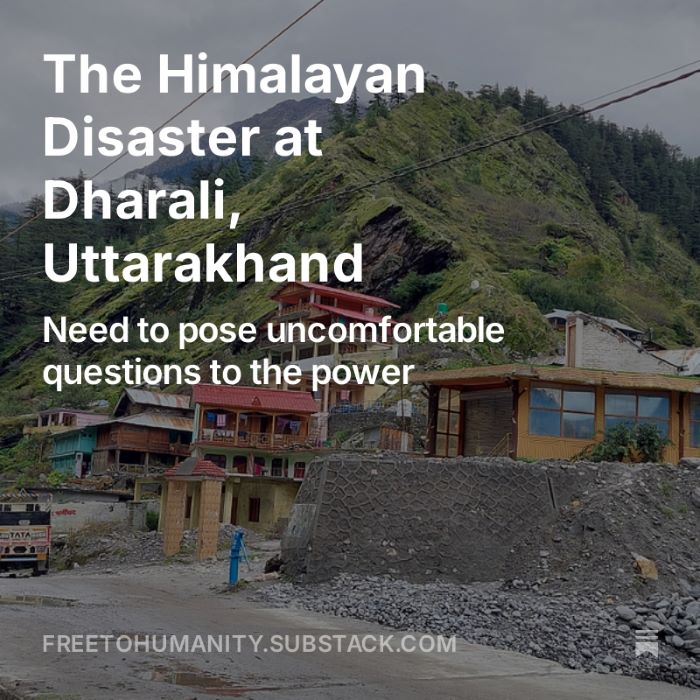
The Himalayan Disaster at Dharali, Uttarakhand
Need to pose uncomfortable questions to the power
SAMAJ WEEKLY UK

Vidya Bhushan Rawat
The avalanche that swept away the entire village of Dharali in the Uttarkashi district of Uttarakhand on August 5th, 2025, has exposed the severely polarised Indian opinion making class apart from the political leadership of various parties which actually behave as if it happened for the first time and wont hit again. There are different sides of this being reported to us. On the one side is the ‘national media’ which I have always described as Manustream media, a PR agency of the ruling party at the Centre which exploit the event as a ‘Pilpli live’ as the live stories of the mass destruction too bring TRPs to these profit mongering companies. The propaganda media these days has always been prioritised over the local ones as they go with all the comfort and state apparatus also take care of them so that they can broadcast the ‘breaking news’. The focus is mostly to broadcast live the ‘action’. Most of the time, we see JCB machine working or army helicopter transporting the people and then people thanking the government and the officials for providing them ‘help’. So, everything is made so overwhelming that nobody has time to ask specific questions to the government. It is definitely good that the government is working over time to provide relief to the people but why is the exact number of people missing or dead is still not known. Why is the government not allowing the local media to cover the event. Why it is gladly providing all the ‘services’ to the ‘national’ media. In fact, some of the ‘local’ media based in Dehradun too got opportunity to take the video shoot from the top but in this entire exercise, the most important role is being played by what we call ‘youtubers’ who have largely been ignored but it is they who traversed the hard terrain on foot to bring the unheard stories of the entire area. They walked in treacherous circumstances from Uttarkashi to Dharali and reported. Most of these fellows are not even termed as ‘journalists’. They deserve kudos for their brave efforts to reach Dharali on foot from Uttarkashi particularly when it continued to rain and national high way remained ‘national’ only for the name sake and had just washed away. These social media reporters or influencers have reported far better than the so called national PR agents who had no time to ask uncomfortable questions. Rather, we are told by every media house as how their reporters were the ‘first’ to reach ‘Dharali’. The only uncomfortable question being posed is that locals have occupied the river bed, built houses and hotels and that is why it happened. Nothing about government policies promoting this rabid mass tourism which resulted in this kind of construction. Who is responsible for authorising them. Will there be any action against the authorities who allowed such construction ? Is there any debate in the government circles about the growing threat of climate crisis and how we need climate friendly solutions. Are they ready to discuss their heavy drilling and excavation of the holy mountains ? And what about our rivers ? Where is the ‘developmental dirt’ going ? Any idea about the limit of infrastructure for the mass bhakt tourism ? How many tonnes of human excreta and other wastes now flows from the Chardham ? Imagine a fair discussion on those. Nobody deny the religious importance of Uttarakhand and Chardham but that need to be respected. Any planning whether religious or non religious, tourism or developmental must include the issues of local traditions, sentiments as well as the climatic issues. You cant promote mass tourism in the name of religion that disturb the already fragile ecology of the region. We must understand that these zones are not merely have the religious importance but also life line of India. Himalayas feed our rivers and Ganga our heritage that link Himalayas to Sundarbans. That apart, Uttarakhand is a border state and not with one but two countries namely China and Nepal.
Dharali’s tragedy has raised various other issues too. And foremost one is the forecasting. Though after the Kedarnath catastrophe in 2013, we heard a lot of noise but nothing much happened except a few warning messages regarding weather but why has it failed to warn people in advance about the possible bursting of Glacial lake or cloud burst. Why has the authorities not been able to gain the information about the possible Glacial Lake formation in the upper stretches of the Khirgad. Why have the warning by the scientists not responded positively. Definitely, this lake formation was not a one day affair ? Why cann’t this be monitored on a regular basis by take a teaming of experts around the Uttarakhand Himalayas, through specialized army helicopters? The satellite images are important but government too need to do it locally. This incident reminded us that of the Rishiganga-Dhauliganga catastrophe in February 2021 which swept away a power project as well as over 200 labours working in it.
Actually, Dharali was ‘waiting’ to happen and it is neither the first one nor the last one which means we have learnt no lesson from it and we will learn nothing. As we build more and more structures without any local framework. Everyone want to have a home stay. Resorts have started in large number. It will come when crores of people are thronging the state for the yatra. The way these yatras have been glamorised would only bring disaster to the Himalayas.
And we don’t discuss the causes and solutions for these. Instead, the so called media as well as others making a grand spectacle of every event where people report the event like heavy machineries, helicopters being used to ferry people, sniffer dogs, big netas visiting and so on. Some of them even ask the people about what happened and who got lost but not about any assistance to them or what will happen to them. These questions are not asked from the Chief Minister as how will people build their life there. Any plan for rehabilitating the people who lost their everything or will government change its industrial, environmental or other policies regarding the hill regions. That is why the media is put in the service of the master so that these uncomfortable questions remain under the wrap. Uttarakhand disasters are not merely natural but also result of the rackless destructive policies being pursued in the name of development. Is that model sustainable ? Should we not think aloud about protecting and respecting our sacred mountains and rivers. I have said it many time and will continue to say, these mountains and rivers, our Pahad, our Ganga-Gad-Gaderas are our identities and our heritage, definitely not a resource to be exploited. Stop treading them resources and exploiting it for your commercial greed.
A few days back, the Supreme Court of India, while hearing a petition, issued a stark warning: “The day is not far when the entire state of Himachal Pradesh may vanish from the map of the country.” The court emphasized the Union of India’s obligation to prevent further ecological imbalance and natural calamities in the state, stating, “Earning revenue is not everything. If things proceed as they are, the consequences will be catastrophic” (Indian Express, August 1st, 2025). This dire observation underscores the escalating crisis in Himachal Pradesh as well as in Uttarakhand, where unchecked tourism, hydropower projects, and environmental degradation are pushing these Himalayan states toward collapse.
Himachal Pradesh has faced heavy losses due to monsoon-related disasters in 2025. According to the State Emergency Operation Centre, the state incurred damages of ₹1,539 crore since the monsoon began on June 20, 2025. The toll includes 94 deaths, 36 missing, and 1,352 houses fully or partially damaged in rain-related incidents (Indian Express, August 2025). A report by NDTV provides a graver picture, noting 173 deaths, 37 missing, and 115 injuries by August 2, 2025, with 23 flash floods and 19 cloudbursts recorded by July 6, 2025 (NDTV, August 2, 2025). Most deaths were rain-related, with Mandi, Kullu, and Kangra districts bearing the brunt, where 243 roads were blocked, 241 electricity transformers disrupted, and 278 water supply schemes rendered non-functional as per a report published by Times of India, July 7, 2025).
Uttarakhand, often competing with Himachal in disaster frequency, recorded 70 deaths by July 4, 2025, including 20 from natural disasters (landslides, cloudbursts, and floods) and 50 from road accidents, with 9 missing (mostly in Uttarkashi) and 177 injured (Times of India, June 29, 2025). Incidents of cloud burst and landslide continue to pour in in the last couple of weeks resulting in disruption in the Chardham yatra for several days but now Dharali disaster has overtaken everything. It is unprecedented but is a wake up call for all of us. So far we don’t know the exact number of the people died or missing.
Unregulated Tourism: A Cultural and Ecological Threat
Both Himalayan states, romanticized as Devbhumi, are reeling under the weight of mass tourism. Uttarakhand welcomed 3.96 crore tourists by July 4, 2025, including 3.94 crore domestic and 1.66 lakh international visitors, with 34.07 lakh pilgrims registered for the Chardham Yatra (13.58 lakh to Kedarnath, 11.52 lakh to Badrinath, 4.97 lakh to Gangotri, 3.99 lakh to Yamunotri) (The Hindu, July 3, 2025; Outlook India, May 16, 2025). Himachal Pradesh recorded 1.4 crore tourists by July 2025, driven by hill stations like Shimla and Manali (Hindustan Times, July 2025). While these numbers boost local economies, they strain fragile ecosystems and infrastructure, exacerbating disaster risks.
The Chardham Yatra, a cornerstone of Uttarakhand’s tourism, has become a symbol of unregulated pilgrimage. By July 2025, 169 pilgrims died due to health issues like cardiac arrest and high blood pressure (78 in Kedarnath, 44 in Badrinath, 24 in Gangotri, 22 in Yamunotri) (Times of India, July 2025). A helicopter crash in April 2025 killed six pilgrims, reflecting the pressure on operators prioritizing profit over safety (The Hindu, July 3, 2025). In Himachal, over-tourism in Kullu-Manali and Shimla has led to traffic congestion and environmental degradation, with tourists littering rivers and flouting local norms (Hindustan Times, June 2025).
As a Pahadi, I see the influx of tourists—often displaying a colonial mindset—threatening our cultural fabric. Young visitors smoke hookahs and drink openly on the banks of the Ganga, while incidents of eve-teasing and disappearances, once rare, are now nightmarish (Deccan Herald, August 2025). The imposition of external cultural practices, including food habits like demanding Maggi, Parathas etc over local delicacies, erodes Pahadi traditions. Some outsiders, backed by political agendas, push a homogenized Hindutva narrative, ignoring the distinct value systems of Himachal and Uttarakhand, where local deities and sustainable practices have long thrived (The Tribune, July 2025). Also it is important to demarcate the religious sentiments from the commercial gains. Actually, last couple of decade, India’s ruling elite has exploited religious sentiments for commercial gains. Frankly, india has been converted into a religious economy with flourishing Babas and new places of miracles in the name of devotion and traditions. Himalayan regions are different and you can not treat them with the low line areas where you have huge land track and no issues related to infrastructure development. In the Himalayan regions, these infrastructural development will come at the cost of the Himalayas and their people only.
Hydropower Projects: Profiting at Nature’s Expense
The Central Government’s push for hydropower, branded as the “potential” of the Himalayas, prioritizes corporate interests over environmental and social costs have been completely exposed now with both the states facing massive disasters though efforts are there to confine the narrative to the ‘what happened and when it happened and not why it happened ? Himachal Pradesh has more than 41 hydropower projects. A report in Down to Earth Magazine says,
‘ hydropower projects are being established in high-risk areas of Uttarakhand. These places in the state may fall prey to seismic or climate-related disasters in the coming years. At least 15 such projects with an investment of around Rs 70,000 crore are in high-risk areas of Uttarakhand.
The report by Climate Risk Horizons notes that 81 large hydropower projects of more than 25 MW in Uttarakhand are in the pipeline and 18 projects are in the works. Threats related to extreme climate have created uncertainty over their future.’
These projects have destroyed our rivers as there is no way to keep the muck away from it. Big boulders,stones, concrete everything is silently being thrown into them many times risking the flow of the rivers. Deforestation, blasting, and sediment disruption weaken and destabilize the slopes in the high mountains which risk sudden burst resulting in calamities like Dharali. Have we forgotten what happened in Joshimath where all the structures have faced cracks. The drilling of big mountains for the Hydropower projects is well documented though not much reported now. It seems every one has now forgotten Joshimath. Villagers of Raini had approached the court against threat to their village but no response from the court. In fact, the Uttarakhand High Court even punished the people including the activists with Rupees ten thousand penalty for filing the case.
Cultural Erosion and “Gujaratification”
The massification of religious tourism has imported lowland practices like Ganga Snan to the Himalayas, where community bathing is rare, and rivers are worshipped, not polluted (The Tribune, July 2025). Loudspeakers, DJs, and drumbeating in Kedarnath disrupt sacred tranquility (The Hindu, July 3, 2025). Cemented structures, mimicking Gujarat’s architectural style, replace Uttarakhand’s unique wooden temples, undermining local craftsmanship and businesses (Deccan Herald, August 2025). The Kanwar Yatra, largely from Haryana and Western Uttar Pradesh, further strains Haridwar’s resources, with no roots in hill traditions (Hindustan Times, July 2025). The people including the priests in holy shrines of Badrinath are protesting against the so called master plan which demolished the local shops and houses of the people living there since their birth. Now, the master plan further concretise the region even at the cost of the traditional methods. Why cant we build our structure as per the suitability of the Himalayas which has traditional Uttarakhandi imprint on it. Is not it an effort to erase our history and traditional system ?
A Call for Sustainable Development
The Supreme Court’s warning demands action. The government’s policies—promoting mass tourism and hydropower for revenue—have fueled this crisis. If the Court is serious, it must regulate tourist inflows, cap pilgrimage numbers, and halt ecologically harmful projects like the Kishau Dam. Sustainable development requires engaging native pahadi communities to preserve local deities, traditions, and ecosystems. The Himalayas are not a colony for exploitation; they are a sacred, fragile region needing protection.
Both Uttarakhand and Himachal Pradesh need to introspect a lot, develop their own model and stop this import of ‘experts’ from outside which actually is a threat to the local traditions and cultural practice under the pretext of development that remained exploitative in nature and unsustainable. While, I would not ask for stoppage of all the hydropower projects or existing programme, I would definitely call for a moratorium on any future planning that hurt our rivers and mountains.
Dharali, Manali, Kulu, Mandi, Reni continues to happen not due to the crisis brought by the local Pahadis but definitely the exploitative nature of developmental model being pursued in the Himalayas by the political elite in connivance with the greedy corporate who shamelessly exploit the religious sentiments of the people, for their personal profiteering even if it damage local ecology and environment. Stop this mindless exploitation of the Himalayas. Perhaps, the only way is now to declare the hill regions under the Schedule V or Schedule VI areas to protect the land being sold to outsiders and stop this commercial greed as well as protect the rights of local communities. A climate friendly solution to this crisis is only possible with inclusive engagement with native people of Uttarakhand and completely halt any future project that endanger Himalayas, its rivers and communities which live around and protect it.