
SAMAJ WEEKLY UK

Bal Ram Sampla
Geopolitics
After gaining independence in 1947, India faced the enormous challenge of developing its economy. The government, led by Prime Minister Jawaharlal Nehru, introduced a system called the “Licence Raj” to control economic development. This system required businesses to get government permission for almost everything they wanted to do. While it was meant to help India grow fairly and prevent inequality, it actually created massive problems including widespread corruption and slow economic growth.
What Was the Licence Raj?
The Licence Raj was a system where the government controlled almost all business activities through licenses and permits. If someone wanted to start a factory, expand their business, import materials, they needed government approval first. The government decided which industries could operate, where they could be located, and what prices they could charge.
This created an extra rules and regulations. Businesspeople often spent years waiting for approvals, filling out countless forms and visiting government offices repeatedly.
Who Was Responsible?
1. Jawaharlal Nehru: was the main person responsible for introducing the Licence Raj. As India’s first Prime Minister, Nehru believed strongly in socialism and central planning.
Nehru was influenced by the Soviet Union’s economic model, which used government planning to develop industry.
2. P.C. Mahalanobis : a famous statistician, helped design the system. He created India’s Five-Year Plans, which set targets for different industries and decided how resources should be used. His ideas became the foundation of India’s planned economy.
3. The Planning Commission: set up in 1950 with Nehru as its head, became the main organization that controlled economic planning. It decided which industries were important, how much money should be invested in them, and where factories should be built.
Dr. Ambedkar’s Different Vision
Dr. B.R. Ambedkar, had completely different ideas about how India’s economy should develop. Unlike Nehru, Ambedkar believed in free markets and limited government control over the economy.
Ambedkar’s Economic Philosophy
Ambedkar was influenced by Austrian school economists like Ludwig von Mises and Friedrich Hayek, who strongly supported free market capitalism (Wikipedia). He believed in:
1. Private property rights and individual economic freedom
2. Competition between businesses rather than government control
3. Decentralized decision-making through markets rather than central planning
4. A stable currency backed by gold rather than government-controlled money
The Contrast with Nehru
While Nehru wanted the government to control most economic decisions, Ambedkar believed that individuals and businesses should be free to make their own choices. He thought that free markets would naturally lead to better outcomes than government planning because:
1. Business owners understand their industries better than government officials
2. Competition encourages innovation and efficiency
3. Government control often leads to corruption and waste
4. Economic freedom is connected to political freedom
Why Ambedkar’s Views Were Ignored
Despite being a founding father of India and a brilliant economist, Ambedkar’s economic ideas were largely ignored when India’s economic policies were being decided. This happened because:
1. Nehru had more political power and influence over economic policy
2. Many people knew Ambedkar mainly as a social reformer fighting for Dalit rights, not as an economist
3. The global trend in the 1950s favoured socialist planning over free markets
4. Ambedkar faced discrimination due to his caste background, which limited his influence in economic discussions
If India had followed Ambedkar’s free market approach instead of Nehru’s socialist planning, the country might have avoided the problems of the Licence Raj entirely. Ambedkar’s ideas were actually very similar to the reforms that India finally adopted in 1991, which led to much faster economic growth.
The Growth of Corruption
The Licence Raj created perfect conditions for corruption to flourish. Since government officials had the power to approve or reject business applications, they could demand bribes in exchange for their decisions. There was widespread corruption that had a trickle down effect in all spheres of society. The poor suffered the most.
How Corruption Worked
1. Businesspeople had to pay “speed money” just to get their files moved and processed
2. Larger bribes were needed to actually get licenses approved
3. Government inspectors regularly visited businesses and could shut them down for small violations, leading to more bribery
4. Officials deliberately delayed decisions to increase pressure for bribes
The corruption existed at every level, from clerks who moved files to senior officers who made final decisions. Some estimates suggest that businesses had to spend 20-30% of their resources just dealing with government procedures and corruption.
Examples of Corruption
1. Import licenses became extremely valuable because they were limited, leading to huge bribes
2. Factory licenses were sold to the highest bidder rather than the most qualified applicant
3. Small businesses suffered the most because they couldn’t afford the bribes that larger companies could pay
Why Was Corruption Ignored?
Despite knowing about the widespread corruption, the Indian National Congress party that ruled India for most of this period did very little to stop it. There were several reasons for this failure:
1. Political Benefits
The licensing system gave politicians enormous power. They could reward their supporters with licenses and punish their opponents by denying them. This helped the Congress party maintain political control, so they had little incentive to change the system.
2. Personal Interests
Many political leaders and their families had business interests that benefited from the system. They opposed reforms.
3. Ideological Stubbornness
Congress leaders genuinely believed that socialism and government control were the right path for India. They were busy filling their pockets.
4. Fear of Change
Politicians worried that dismantling the system would lead to job losses in government offices and hurt protected industries, which could cost them votes.
5. Powerful Opposition
The system created wealthy beneficiaries – protected businesses, government officials, and middlemen – who had the resources and influence to resist any changes.
The Economic Cost
The Licence Raj had serious negative effects on India’s economy:
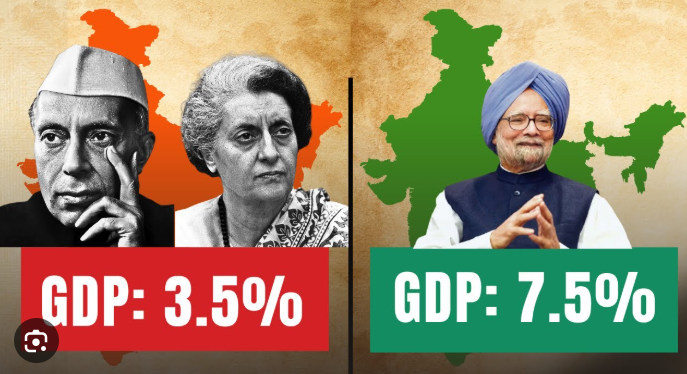
1. Economic growth remained very slow, at only 3-4% per year (called the “Hindu rate of growth”)
2. Indian businesses became uncompetitive compared to companies from other countries
3. Innovation was discouraged because businesses were more focused on getting government approvals than improving their products
4. Small businesses struggled to compete because they couldn’t afford the bribes and delays
Hindu rate of Growth
The “Hindu rate of growth” was a term used to describe India’s persistently low economic growth rate during the Licence Raj era. Origin of the term: The phrase was coined by economist Raj Krishna in the 1970s.
Conclusion
The Licence Raj was introduced to ensure fair economic development and prevent the concentration of wealth. However, it became a system that actually hindered India’s progress. The extensive government control created opportunities for massive corruption, which the ruling party largely ignored because it served their political interests.
The contrast between Nehru’s and Ambedkar’s economic philosophies shows that India’s founding fathers had very different visions for the country’s economic future. While Nehru’s socialist approach dominated policy-making, Ambedkar’s free market ideas were largely overlooked, despite his expertise as an economist and his crucial role in drafting the Constitution.
This system continued for over four decades until India faced a severe economic crisis in 1991. Only then did the government finally begin dismantling the Licence Raj and opening up the economy to market forces. Ironically, the 1991 reforms were much closer to what Dr. Ambedkar had advocated decades earlier – emphasizing free markets, competition, and reduced government control over business decisions.
References
1. https://swarajyamag.com/economy/ambedkar-the-forgotten-free-market-economist Ambedkar: The Forgotten Free Market Economist
2.https://en.wikipedia.org/wiki/B._R._Ambedkar
3. Licence Raj before 1991
http://indiabefore91.in/license-raj
4. Licence Raj
https://www.ksgindia.com/blog/license-raj.html