SAMAJ WEEKLY UK
By Vidya Bhushan Rawat*
The police brutality unleashed against peaceful protesters at Jantar Mantar is neither new nor exceptional. It reflects a structural problem in our policing system. The police have long served those in power, often becoming instruments of political authority rather than protectors of citizens’ rights. The difference today is that earlier governments, at least occasionally, held the police accountable for unlawful actions. Today, however, the government itself appears increasingly driven by the bureaucracy and the police establishment.
One only needs to look at the unprecedented number of service extensions granted to senior bureaucrats. What was once an exception has become the norm. Equally striking is the absence of ministerial resignations. Accountability has little place in Narendra Modi’s political culture because many decisions formally attributed to ministers are, in reality, perceived to emanate from the Prime Minister’s Office. Ministries increasingly appear to function not as autonomous institutions but as mechanisms for centralised control.
The larger consequence has been the systematic weakening of public institutions. Over the past twelve years, perhaps the defining achievement of the present regime has been the selective dismantling of institutional autonomy while simultaneously expanding access for politically connected private interests at every level of decision-making.
We often recall the Emergency imposed by Indira Gandhi as the darkest chapter in independent India’s democratic history. Yet today’s circumstances raise equally troubling questions. During the Emergency, sections of the judiciary and the media continued to resist state excesses despite severe restrictions. Today, many institutions that were expected to safeguard constitutional democracy appear increasingly willing to justify executive overreach.
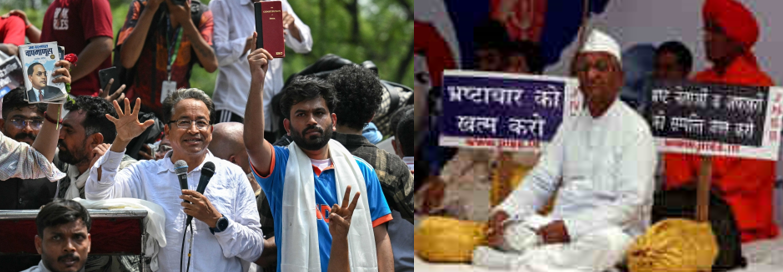
The contrast becomes even sharper when one remembers the Anna Hazare movement. During those protests, Delhi Police largely adopted a permissive approach. Slogans proclaiming “Delhi Police Hamare Saath Hai” echoed through the streets. Senior bureaucrats openly sympathised with the movement. Kiran Bedi sat on dharna alongside V.K. Singh, Arvind Kejriwal, Prashant Bhushan and many others. The crowds at Jantar Mantar and Ramlila Maidan created the illusion that they represented the voice of the entire nation.
Looking back, that movement deserves a more critical assessment. I have always argued that it is not enough to identify a problem; one must also examine the solutions being proposed. Too often, the proposed solution proves more damaging than the original problem itself. The anti-corruption movement ultimately delegitimised the Congress Party while normalising the Sangh Parivar in mainstream political discourse. The Aam Aadmi Party emerged from that movement, but it was the BJP that reaped its greatest political rewards. Those who once celebrated the movement as a democratic awakening are conspicuously silent today.
The people have not changed as much as the narratives surrounding them. During the Anna movement, it was considered a democratic right to demand answers from the government and occupy public spaces in protest. Today, many of the same commentators who applauded those demonstrations dismiss student protests as conspiracies, sometimes even invoking Pakistan without evidence. This marks perhaps the greatest difference between then and now. During the Emergency, significant sections of the media questioned state excesses. Today, too many television studios have become platforms for defending them.
When the media abandons journalism and instead seeks to provoke protesters, distort facts, and manufacture narratives to discredit popular movements, confrontations become inevitable. The assault on journalists at Jantar Mantar was wrong and deserves unequivocal condemnation. Yet one must also ask why public trust in sections of the media has deteriorated so sharply. Journalism cannot survive merely by amplifying power while neglecting its duty to question it.
Recently, a prominent television editor strongly condemned the violence against journalists at Jantar Mantar. That condemnation was appropriate. But the larger question remains: do we still have an independent media, or have many television networks become little more than political echo chambers manufacturing narratives for partisan audiences? Anyone whose understanding of India is shaped exclusively by nightly prime-time shouting matches is likely to discover how detached those narratives are from reality. Prime-time television has become one of the greatest disservices to informed public debate.
The response of the Cockroach Janta Party (CJP) has, so far, been relatively measured. It has sought to keep the protests peaceful and inclusive—precisely the qualities that threaten those who thrive on social division and communal polarisation.
The Congress Party and Rahul Gandhi also made a strategically sound decision. By first raising the issue in Parliament and then joining the protests on the streets, they avoided the accusation of attempting to hijack a student-led movement. However, the police’s excessive use of force and the government’s refusal to engage meaningfully with the students created a natural point of political intervention for the opposition.
The behaviour of the police once again exposed a deeper institutional culture. Wearing the uniform too often becomes synonymous with exercising unchecked power rather than serving citizens. That culture was on full display at Jantar Mantar.
When Rahul Gandhi later led Congress workers to the gates of Lok Kalyan Marg, the Prime Minister could have chosen dialogue over confrontation. Instead, the opportunity was lost. The police response only strengthened Rahul Gandhi’s political standing. Those who questioned his absence from the earlier stages of the movement now see that his intervention has broadened its political significance.
Similarly, the detention of Akhilesh Yadav energised Samajwadi Party workers across Uttar Pradesh, while Mamata Banerjee has already taken to the streets in West Bengal. Unlike many previous protests, this movement appears to include sections of society once regarded as reliable supporters of the BJP. Many now feel that promises made to them have remained unfulfilled, particularly regarding employment and quality education.
This perhaps explains the government’s anxiety. Rather than addressing the underlying concerns, it appears more focused on constructing conspiracy theories while sympathetic television channels legitimise police action and place the blame squarely on students.
Encouragingly, some voices from the film industry have finally begun speaking out. Shabana Azmi, Naseeruddin Shah, Sonu Sood and Riteish Deshmukh have expressed concern, among others. Yet many public figures remain cautious, carefully framing their criticism around Sonam Wangchuk or the students while avoiding any appearance of aligning with the Congress Party or the INDIA alliance. Their criticism remains measured, revealing the continuing pressures of political polarisation.
The silence of India’s self-proclaimed “Mahanayak” is perhaps even more revealing. For years, celebrity culture and television spectacles such as Kaun Banega Crorepati have projected the comforting illusion that success depends solely on individual merit. Such narratives overlook the structural inequalities confronting millions of young Indians.
The government may have assumed that YouTube, Instagram and the creator economy would satisfy an aspirational generation. Increasingly, however, young people recognise that social media cannot substitute for stable employment, quality education or economic security. Digital popularity cannot create jobs for the millions graduating from India’s universities each year.
What India urgently needs is a serious national conversation about education, employment and institutional reform. Parliament should become the forum where the government and opposition debate these issues constructively. But before that can happen, those responsible for reducing public institutions to centres of patronage and corruption must be held accountable.
The coming days will be critical. Emotions are understandably running high. Yet anger alone cannot build institutions. India requires thoughtful leadership capable of restoring faith in democratic processes.
I continue to believe that socialism remains a positive constitutional principle because it places the state under an obligation to ensure public welfare. Education, healthcare, agriculture, pharmaceuticals and land reforms were central to the constitutional vision of India’s founders. Socialism remains embedded within the constitutional framework, and governments must honour that commitment.
If these movements have achieved one positive outcome over the past decade, it is the revival of idealism among young Indians. The ideals of Bhagat Singh and Dr. B.R. Ambedkar continue to inspire a democratic and egalitarian vision for India. Ambedkarite and Left democratic forces should work together in pursuit of constitutional values and social justice.
Finally, one must acknowledge the courage displayed by the AISA members at Jantar Mantar. One hopes that wisdom prevails, that Parliament allows a meaningful debate on the concerns raised by students, and that India responds to this moment not with repression but with dialogue.