
SR Darapuri I.P.S.(Retd)
 (Samajweekly) The Manusmriti, also known as the Laws of Manu, is one of the most influential texts associated with the traditional Hindu social order. For centuries it has been regarded by many as a source of guidance on social organization, duties, and moral conduct. However, it has also been one of the most controversial texts in Indian history because of its role in legitimizing caste hierarchy and social inequality. Two prominent modern thinkers who engaged with the Manusmriti were Dr. B.R. Ambedkar and the German philosopher Friedrich Nietzsche. While Nietzsche admired the text for its defence of hierarchy and social order, Ambedkar strongly condemned it as a source of oppression and injustice. Their contrasting interpretations reveal fundamentally different conceptions of society, morality, and human dignity.
Dr. B.R. Ambedkar viewed the Manusmriti as one of the principal ideological foundations of the caste system in India. According to him, the text institutionalized social inequality by assigning individuals a fixed status based on birth rather than merit or achievement. It divided society into rigid categories and denied social mobility to those placed at the lower levels of the hierarchy. Ambedkar argued that the Manusmriti not only justified discrimination against Shudras and so-called “untouchables” but also imposed severe restrictions on women and denied them equal rights and freedoms.
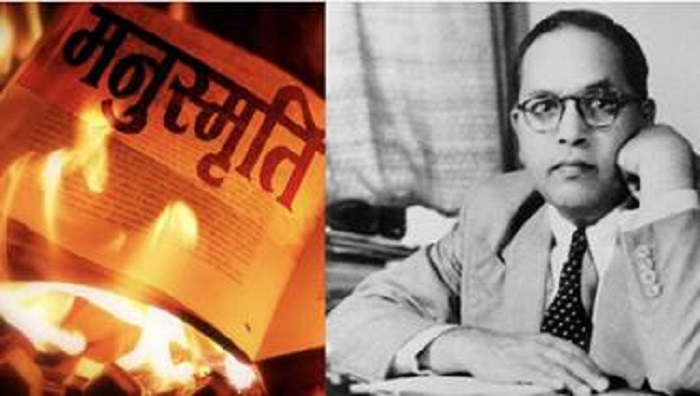
For Ambedkar, caste was not merely a social arrangement but a system of graded inequality that destroyed fraternity and human solidarity. He believed that the Manusmriti provided a religious sanction for this oppressive system and thereby became a major obstacle to the creation of a democratic and egalitarian society. His opposition to the text was so profound that in 1927, during the Mahad Satyagraha, he publicly burned copies of the Manusmriti as a symbolic rejection of caste-based oppression and social exclusion.
Ambedkar’s critique was rooted in his commitment to the principles of liberty, equality, and fraternity. He argued that no society could be genuinely democratic if it accepted social hierarchy based on birth. In his view, the values embodied in the Manusmriti were fundamentally incompatible with modern democracy, human rights, and social justice. Consequently, he called for the annihilation of caste and the reconstruction of society on the basis of equality and human dignity.
Friedrich Nietzsche, by contrast, approached the Manusmriti from a very different intellectual perspective. Writing in nineteenth-century Europe, Nietzsche was a fierce critic of Christianity and modern egalitarianism. He believed that societies flourish when they recognize differences in ability, strength, and excellence among individuals. As a result, he was attracted to aspects of the Manusmriti that appeared to affirm hierarchy, rank, and social differentiation.
Nietzsche regarded the Manusmriti as an example of what he considered an aristocratic moral order. He contrasted it favourably with Christianity, which he accused of promoting weakness, conformity, and resentment. In Nietzsche’s view, the Manusmriti represented a society that openly acknowledged differences among people and organized itself according to principles of rank and authority. He admired what he perceived as its realism and its rejection of the doctrine of universal equality.
However, Nietzsche’s interpretation was largely philosophical and abstract. He was not concerned with the historical experiences of those who suffered under caste discrimination. Rather, he used the Manusmriti as a weapon in his broader critique of Christian morality and democratic egalitarianism. His interest lay in its symbolic value as an alternative model of social organization rather than in its practical consequences for human beings.
Ambedkar strongly disagreed with Nietzsche’s admiration for the Manusmriti. He recognized that Nietzsche’s concept of the “superman” (Übermensch) shared certain similarities with Manu’s celebration of hierarchy. Yet Ambedkar argued that both perspectives ultimately justified social inequality and the domination of some groups over others. For Ambedkar, no theory of society could be morally acceptable if it denied the equal worth and dignity of every human being.
The contrast between Ambedkar and Nietzsche reflects a broader philosophical conflict between equality and hierarchy. Nietzsche feared that equality would suppress excellence and creativity, while Ambedkar believed that hierarchy inevitably produced oppression and denied opportunities to large sections of society. Nietzsche sought a society organized around rank and distinction; Ambedkar sought one founded on justice, freedom, and social inclusion.
In conclusion, the Manusmriti became a point of profound disagreement between Dr. B.R. Ambedkar and Friedrich Nietzsche. Nietzsche admired it as a model of aristocratic social order and a challenge to egalitarian values. Ambedkar, on the other hand, regarded it as a source of caste oppression, social exclusion, and human suffering. Their opposing interpretations continue to influence contemporary debates about caste, democracy, equality, and social justice. Ultimately, the disagreement between Ambedkar and Nietzsche is not merely about an ancient text; it is about two competing visions of human society—one based on hierarchy and privilege, and the other on equality and human dignity.