SAMAJ WEEKLY UK
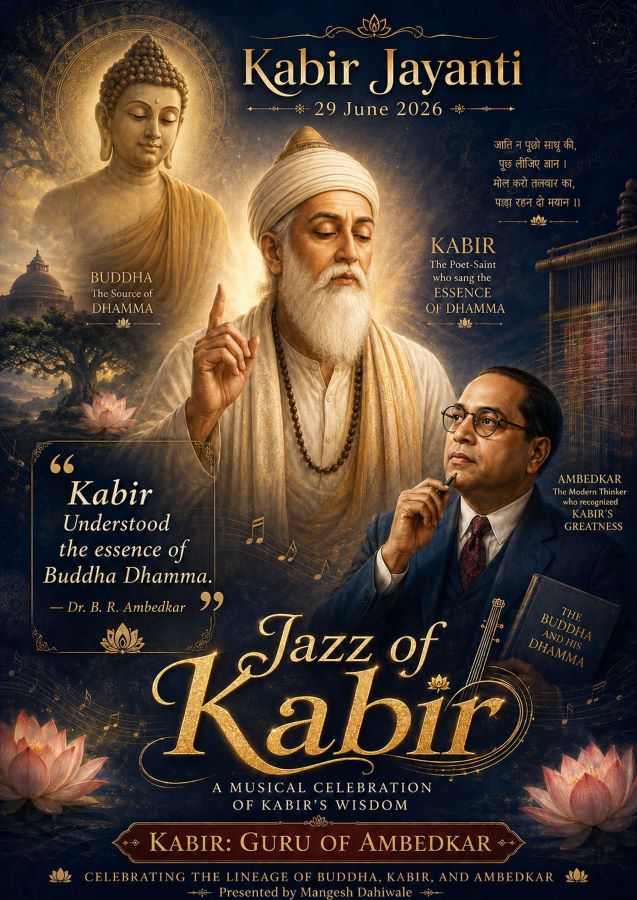
On the sacred occasion of Kabir Jayanti, 29 June 2026, I am delighted to announce the formal release of Jazz of Kabir, a ten-song musical journey into the fearless, compassionate, and liberating vision of Sant Kabir.
Kabir sang against caste, ritualism, religious arrogance, and every wall constructed between one human being and another. His words emerged from the loom, the street, the marketplace, and the ordinary human body, yet they opened towards a truth beyond names, boundaries, and inherited identities.
For Dr. B. R. Ambedkar, Kabir was not merely a medieval poet. Kabir was one of his gurus, a vital presence in the moral and intellectual lineage that led him towards liberty, equality, fraternity, and the Buddha Dhamma.
“Kabir understood the essence of Buddha Dhamma.”
Dr. B. R. Ambedkar
Jazz of Kabir brings Kabir’s voice into conversation with jazz, a musical form born from suffering, resistance, improvisation, freedom, and the search for an unbounded human expression. The album does not attempt simply to decorate Kabir’s poetry with music. It listens to the tensions within his words: silence and sound, body and breath, love and rebellion, solitude and fellowship, the visible world and the truth hidden within it.
Each composition approaches Kabir as a living voice speaking urgently to our own time.
THE SONGS
1. The World Is Mad
The album opens with Kabir looking upon a world in which falsehood is celebrated and truth is punished. The song asks what happens when greed, hierarchy, and collective delusion begin to appear normal, while honesty itself is treated as madness.
2. Who Made You Mad?
Kabir turns the accusation back upon society. Who divided one humanity into religions, castes, names, and competing identities when everyone is formed from the same clay, sustained by the same breath, and carried by the same fragile body?
3. Touch
A direct confrontation with untouchability and the imagined purity of caste. The song reminds us that every body is shaped upon the same wheel, born through the same processes, and animated by the same breath. What, then, can make one human being polluting to another?
4. The Upside-Down River
Kabir’s paradoxical imagination comes alive in a world where rivers flow upward and the familiar order is overturned. The song invites the listener to abandon habitual perception and enter the strange, liberating landscape of Kabir’s ulatbāṃsī, his poetry of inversion.
5. Is It Two or One?
When names, doctrines, castes, and identities fall away, what remains? This contemplative composition moves through the illusion of separation and repeatedly asks the simplest and most difficult question: are existence and the one who experiences it truly two, or one?
6. Only This
The seeker travels outward in search of truth, only to discover that the one being sought was already looking through these very eyes. A quiet song of recognition, it turns the journey inward without creating another doctrine, possession, or metaphysical certainty.
7. The Wine of Love
Kabir’s language becomes ecstatic. There is no cup, no drinker, and no boundary between lover and beloved. Only love remains, dissolving the carefully guarded self in an experience that cannot be contained by ritual or explained by theology.
8. The Instrument of Sky
The human body appears as a mysterious instrument stretched between earth and emptiness. Breath becomes rhythm, the nerves become strings, and consciousness becomes music. Yet the essential question remains: are we playing the instrument, or is something immeasurable playing through us?
9. Where Are You Going Alone?
A song addressed to the solitary traveller who imagines that possessions, status, and identity can accompany them forever. Kabir gently but relentlessly reminds us that the road must finally be walked without the burdens we spent a lifetime accumulating.
10. The Word Without a Tongue
The album culminates in a four-movement suite exploring the mystery of the Shabda, the word that is not merely spoken and the sound that cannot be confined to language.
Movement I: Before the Word
The listener enters the silence from which every sound arises. Before doctrine, before naming, and before the voice divides experience into categories, there is an attentive and unpossessed awareness.
Movement II: Unrepeated Repetition
A phrase returns, but never in exactly the same form. Like breath, memory, and improvised music, repetition reveals impermanence. What appears familiar is being born anew at every moment.
Movement III: The Ascent
Sound rises through the body, not as an escape from earthly life but as a deepening of attention. The movement gathers intensity as breath, rhythm, longing, and awareness move towards a luminous opening.
Movement IV: The Sound Continues
The final notes do not close the journey. They return the listener to silence with a final invitation: do not possess the silence or turn it into another belief. Listen before the word. Listen after the word. Listen where no word is needed.
AN INVITATION
On this Kabir Jayanti, I warmly invite you to enter this album slowly and attentively. Listen not only to its melodies and improvisations, but also to the questions Kabir places before us.
Who created the divisions between us?
What remains when names disappear?
What is this body?
Who is listening?
Can love survive possession?
Can truth be heard before it becomes a doctrine?
May Jazz of Kabir become a meeting place between the Buddha’s Dhamma, Kabir’s fearless Vani, Ambedkar’s emancipatory vision, and the boundless freedom of music.
Please listen, share, and allow Kabir’s voice to travel further.
Jazz of Kabir
Formally released on Kabir Jayanti
29 June 2026
Presented and composed by Mangesh Dahiwale